Showing posts with label spectacle. Show all posts

Sunday, 21 July 2024

An Ambitious Project: Understanding the Interface of the Spectator and the Spectacle

This is an unpublished and unused blog post from late 2013 that was originally intended as one of the introduction posts for the Ways 2 Interface project.


Ways of Understanding

Ways 2 Interface is the continuation of a research project that I initiated in October 2012 and which culminated in Ways of Being: The Spectator and the Spectacle, my graduate theoretical dissertation. 

The 30,000 word paper was praised for its boldness, progressive thinking and received the highest mark that has ever been awarded to a Film and Screen Studies dissertation at Bath Spa University; as well as being awarded the Media Futures Research Award for Excellence in Film and Screen Studies research.
 
The primary content (Introduction, Chapter One, Chapter Two and Conclusion) was only half the paper!

"This is a well researched, conceptually sound and cogently argued dissertation which is striking in its originality of argumentation and in its nuanced reading of a wide range of film and critical material. It draws on a plethora of examples from traditions of visual culture from prehistoric cave art to contemporary film, the IMAX experience and future practices of audio‐visual consumption in order to examine traditional and contemporary theories of spectatorship and the spectator’s relation with the spectacle. The introduction clearly sets out the structure and methodology of the dissertation and provides a useful overview of the technological shifts which have resulted in a reconfiguration of the relationship between the viewer and the viewed. This is clearly an ambitious project. It makes a passionate case for the revival of grand theory in studies of Spectatorship in particular and Film Studies in general and sustains this case through argumentation of an exceedingly high order. It acknowledges the need to expand the scope of such studies beyond film, in its reference to a wide range of media texts as much as to critical literature, all of which are directed towards an understanding of spectatorship from points of view as diverse as the sensory, experiential, philosophical, spiritual, metaphysical and neuorological."

(Dr Suman Ghosh, Lecturer in Film and Screen Studies).

However, as I commented in the paper, Ways of Being only served as an introductory speculation and there was a great deal of research material and other speculative thinking that I was not able to deal with in the paper. Futhermore, I continued to conduct research for the project even after I had submitted the paper in June 2013. Hence, my incentive to orchestrate Ways 2 Interface.


Looking Beyond Seeing

While my intentions for my theoretical dissertation were originally very different, a deep-seated inclination (intensified by my first exposure to IMAX) steered me towards a reconsidertation of our understandings of the relationship of the spectator and the spectacle. 

This reconsideration was first centered on film, but very quickly broadened to include all forms of audio visual content. This inclination was further intensified (as the choice of titles for my paper and this platform will testify) when I was introduced to John Berger's Ways of Seeing.


“I want to question some of the assumptions usually made about the tradition of European painting. That tradition that was born about 1400, died about 1900. Tonight, it isn’t so much the paintings themselves which I want to consider, as the way we now see them. Now, in the second half of the 20th century, because we see these paintings as nobody saw them before. If we discover why this is so, we shall also discover something about ourselves and the situation in which we are living.” (Berger, 1972).

Berger's considerations are very much steeped in the theoretical traditions of Lacanian psychoanalysis. Like other radical thinkers, Berger was infleunced by the explanations a psycoanalytical account could provide for the spectator's relationship with any type of spectacle and, in turn, Berger served as a pioneer in the establishment of a wider academic grounding of spectatorship study in the 1970s. 


Seeing the Gaze

Key among these areas of study was that of the Gaze, as pioneered in Film Studies. Gaze theory argued that there is an ideology: 

"a ‘way of seeing,’ structured into visual representations and the way those presentations address spectators” (Williams, 1994:1). 

Therefore, the gaze refers less to the process the spectator employs to view a film and  more to the way in which a film is a constructed gaze - a particular way of seeing something - that the spectator adopts while watching a film. 

The gaze was wholly reliant on a psychoanalytical explanation and it posited that a spectator is a sumissive componant of a larger cinematic/spectacle apparatus and adopts whatever mindset or ideology a particular cinematic/spectacle apparatus embodies: 

"film theorists argued that the kind of deception that cinematic illusion wrought upon the film spectator was a precise instantiation of the kind of deception wrought by ideology upon the individual” (Allen, 1998:7). 

Two-and-a-half thousand years old, Plato's simile of the cave acts a surprisingly good illustraion of the apparatus, gaze theory and classical film theory's somewhat complacent treatment of the spectator and spectacle as a whole.

“Imagine an underground chamber like a cave, with a long entrance open to the daylight and as wide as the cave. In this chamber are men who have been prisoners there since they were children, their legs and necks being fastened that they can only look straight ahead of them and cannot turn their heads. Some way off, behind and higher up, a fire is burning, and between the fire and the prisoners and above them runs a road, in front of which a curtain-wall has been built, like the screen art puppet shows between the operators and their audience, above which they show their puppets… Imagine further that there are men carrying all sorts of gear along behind the curtain-wall, projecting above it and including figures of men and animals made of wood and stone and all sorts of other materials, and that some of these men, as you would expect, are talking and some not.” (Plato, 2003:241)

However, the theory of the gaze and the apparatus was heavily critisised with the emergence of cognitive film theory. The main criticism was that the gaze and the apparatus provided a one-sided explanation and delegated the spectator to a function where the actual audience member was non-existent. 

The gaze and the apparatus did not account for the cognitive input a spectator brings to a film or spectacle experience - it did not provide an account of both sides of the relationship.


Ways of Thinking and Feeling

Cognitive Film Theory presents a two-sided account of the spectator and spectacle, where the actual audience member, based on their individual life experience, is just as much as involved in the creation of a way of seeing a film or spectacle: “Viewers cannot absorb cinematic images any more than they can absorb reality. Instead they undertake a perceptual dialogue, seeing in part what their schemas encourage them to seek out, and in part what the artist’s shaping of cinematic form encourages them to see" (Nadaner, 1984:126).
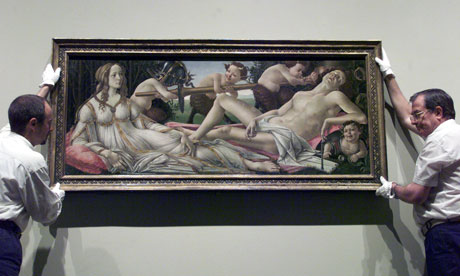
Repositioning Botticelli's Venus and Mars.

While Berger does favour a psychoanalytical approach, there is something of a cognitive pronouncement in his theorising: 

“The invention of the camera has changed not only what we see, but how we see it. In a crucial but quite simple way, it has even changed paintings painted long before it was invented. The painting on the wall, like a human eye, can only be in one place at one time. The camera reproduces it, making it available in any size anywhere, for any purpose. Botticelli’s Venus And Mars used to be a unique image which it was only possible to see in the room where it was actually hanging. Now its image or detail of it, or the image of any other painting which is reproduced, can be seen in a million different places at the same time. As you look at them now, on your screen, your wallpaper is around them. Your window is opposite them. Your carpet is below them. At this same moment, they are on many other screens, surrounded by different objects, different colours, different sounds. You are seeing them in the context of your own life” (Berger, 1972).

While cognitive film theory flourished throughout the 1980s and 1990s, developments in Film Studies, over the past ten years, have been pushing the boundaries of understanding even further.  

Film Theory: An Introduction Through the Senses by Thomas Elsaesser and Malte Hagener serves something as the culmination of this expanded thinking and of all previous film theoretical thinking besides. 

However, Elsaesser and Hagener posit that all lines of thought in film theory have been at fault by not considering the human body as a required variable and construct in the study of the spectator and the spectacle: 

"Each type of cinema (as well as every film theory) imagines an ideal spectator, which means it postulates a certain relation between the (body of the) spectator and the (properties of the) image on the screen, however much at first sight the highlighted terms are "understanding" and "making sense", "interpretation" and "comprehension". What is called classical narrative cinema, for instance, can be defined by the way a given film engages, addresses and envelops the spectatorial body. Films furthermore presuppose a cinematic space that is both physical and discursive, one where film and spectator, cinema and body encounter one another. This includes the architectural arrangement of the spectatorial space (the auditorium with its racked seating), a temporal ordering of performances (separate sessions or continuous admission) and a specific social framing of the visit to the movie-theater (a night out with friends, or a solitary self-indulgence), the sensory envelope of sound and other perceptual stimuli, as well as the imaginary construction of filmic space through mise-en-scene, montage and narration. Likewise, bodies, settings and objects within the film communicate with each other (and with the spectator) through size, texture, shape, density and surface appeal, as much as they play on scale, distance, proximity, color or other primarily optical markers. But there are additional ways the body engages with the film event, besides the senses of vision, tactility and sound: philosophical issues of perception and temporality, of agency and consciousness are also central to the cinema, as they are to the spectator. One of the challenges of our task was to tease out from formalist and realist theories their respective conceptions of cinema's relation to the body, whether formulated normatively (as, for example, in the approaches of both Sergej Eisenstein and Andre Bazin, however opposed they might be in other respects) or descriptively (more typical, at least in rhetorical strategy, of phenomenological and other contemporary theories)" (Thomas Elsaesser & Malte Hagener, Film Theory: An Introduction through the Senses, pages 4-5)

Study in bed, not in the library. Especially when it's cold!

Furthermore, Elsaesser and Hagener argue that by reconsidering classic and contemporary film theory in relation to the inclusion of the bodily perspective will enable a greater and unifying understanding of the spectator and the spectacle:

"The idea of the body as sensory envelope, as perceptual membrane and material-mental interface, in relation to the cinematic image and to audio-visual perception, is thus more than a heuristic device and an aesthetic metaphor: it is the ontological, epistemological and phenomenological "ground" for the respective theories of film and cinema today" (Thomas Elsaesser & Malte Hagener, Film Theory: An Introduction through the Senses, pages 11)

Upgrading Our Understanding

Ultimately, these four components - Ways of Seeing, the gaze, cognitive film theory and Film Theory: An Introduction Through the Senses - served as the 'way in' for the Ways of Being project; they provided an essential account of the explanations of the spectator and spectacle relationship which already existed in the academic sphere. 

My aim, as was Berger's and Elsaesser's and Hagener's, was to reconsider these established presumptions and, through doing so, construct a greater understanding of a our larger ways of being: "the situation in which we are living.” (Berger, 1972). 

In Ways of Being I proposed a case to transition the academic study of film and the spectator from its cave-like complacency and re-position it firmly in the current age of the upgrade. 

My aim is the same for Ways 2 Interface.

The Interface: Reconsidering the Terminology and the Perspective of Understanding

The following is an unpublished post from 2014 that would have formed one part of the introduction for the Ways 2 Interface research project. 

Re-asserting Grand Theory with Practical Validation

While the seed for Ways 2 Interface was always germinating throughout the process of orchestrating Ways of Being, the seed for this project's essential aesthetic focus was established in Appendix I: The Multiplex is in your PocketAppendix I, with Appendix F: The Multiplex is in Trouble, was originally going to form Chapter Three of the paper's primary content, but this extra chapter was disbanded when I severly went over the primary content's required word count. 

However, in The Multiplex is in Your Pocket I touched on the concept of the interface:
  • the external physical interface, such as an iPad or cinema screen, through which the consumer directly experiences content. 
  • the theoretical construct interface, such as the gaze in Todd's McGowan's The Real Gaze: Film Theory After Lacan, representing the point at which a spectator and spectacle come into contact
  • the neuorological interface, as posited in Film Theory: Introduction Through the Senses, where the spectator and the spectacle interact on a neurological or neurobiological level. 
While I am championing the need to extend the scope of understanding, as an essential philosophical pursuit, I am also asserting a need to change/re-clarify the ways in which we discuss the relationship:
"we need to understand how the spectator views, absorbs, receives, engages, experiences, constructs, desires, negotiates, manipulates, participates, fantasises, debates, infers, identifies, critiques, addresses, senses, recreates and integrates with the cinematic fiction. The problematic nature of terminology and diversity in film theorisation goes to the very heart of this thesis’ focus" (O'Brien, 2013:36).

The inadacacies of terminology and definition were something that I continously came back to in Ways of Being

"Beyond celluloid film being discontinued, does ‘film’ refer to just theatrically produced entities or does it also refer to entities produced for television and the internet? Likewise, what is ‘cinema’ referring to: the physical cinema location, an artistic temperament or the industry as a whole?" (O'Brien, 2013:111). 

In Appendix A, I even went so far as to suggest a replacement for 'the spectator' and 'the spectacle' terms; respectively, these I repositioned as 'the percieving participator' and 'the spectacle experiencing situation'. While these were only hyperphetical, I created these new terms to demonstrate the shortcomings of current terminology. 


Defining the Components

As I have already noted, my paper argued for the inclusion of the body and, therefore, a greater sensory consideration; to this end, to describe an audience member as a viewer or spectator - an entity that is reliant on the information going through the eyes - is not a fair representation of the true sensory experience that actually occurs when experiencing a film (you should note that I tend to use 'experiencing' opposed to the more typically used 'viewing').


Do we view or do we feel films? 

I was never one hundred percent happy with the terms of the percieving participator and the spectacle experiencing situation; in fact, I think they are too clunky, but they still demonstrate a need for the current terminology to be clarified in regards to whatever context those terms are presented within. 

I am no linguist, but until clarity is brought to the way in which we discuss the subject, how can we ever hope to disect this thing that we call 'cinema', 'film', 'the movies', 'content' if we can not even define its delivery and reception processes properly? 

In the paper and here also, I do use the terms 'spectator' and 'spectacle', because they are specific enough to refer to a film and an audience member and loose enough to refer to other forms of media and presentation that cater for audience members (they sounded better as a title as well).

Spectator
noun. 
A person who watches at a show, game, or other event: around fifteen thousand spectators came to watch the thrills and spills.

Spectacle
noun. 
A visually striking performance or display: the acrobatic feats make a good spectacle.
[mass noun]: the show is pure spectacle an event or scene regarded in terms of its visual impact:the spectacle of a city’s mass grief.

(Oxford Dictionaries, 2013)

However, their emphasis on the visual does still bother me and if some better terms come along, then I will certainly use them. For the time being, though, I rely fully on the context in which I utilise these two terms; it is a context in which a greater sensory influence is at work:

“[in terms of our growing understanding of film spectatorship] we have stopped viewing spectacle content on a screen, and we now experience and interact with it via an interface. If there is a great deal of neurobiological participation happening on the spectator’s part, then perhaps this offers a more accurate way to talk about the process by which the spectator interfaces with any type of film spectacle” (O'Brien, p. 2013).

The Process of Interfacing

The interface allows us a means through which to more properly discuss and to concieve of the means by which a spectator and a spectacle interact with one another. The reflexive nature inherent in the definition and function of an interface allows us to see the relationship of the spectator and the spectacle as being something that has a back-and-forth inclination on both fronts - two faces/systems interacting with one another - and which also provides something of a concept of a middle-ground between those two interfacing components. 

The interface: the place/device/situation where spectator interacts with spectacle, where spectacle interacts with spectator. The interfacing and the process of interfacing are representative of an essential way of being that is integral to human nature and it has something to do with cause and effect, to want and to attain, the fantasy and the reality, the creator and the monster, excitement and crescendo, life and death. Basically, if I could define what it is, I would not have to orchestrate this research project! I believe as much as it is concerned with the physical delivery and neurobiological reception methods, it is equally tied up with a cognitively abstract, even psychoanalytical, understanding of the explorer and the explored. 

Different media and different mindsets all mixed up.

I feel as a means to approach this subject from a progressive and combined perspective 'interface' offers the best focus from which to start. Hence, my reasoning for establishing it as the starting point and ultimate ending focus of the second phase of this research project.


Read part 6 of the introduction - The Network-Narrative: Understanding the Spectator's World Wide Interfacing Relationship with the Spectacle

Thursday, 2 April 2015

The Language of Hollywood: Storytelling, Sound and Colour - MOOC Review & Reflection


A very insightful free online course that uses some less known film examples to explore the evolving aesthetics and technologies of hollywood filmmaking. Ultimately, the entire course acts as a widely accessible overview and introduction to the study of hollywood cinema.

I recently undertook and have now completed The Language of Hollywood: Storytelling, Sound and Color MOOC as hosted on Coursera. 

My Statement of Accomplishment.

In the video below I reflect on my experience of undertaking the MOOC and discuss what I ultimately gained from that experience...


Overall, a very insightful free online course that uses some less known film examples to explore the evolving aesthetics and technologies of hollywood filmmaking. Ultimately, the entire course acts as a widely accessible overview and introduction to the study of hollywood cinema.

The Language of Hollywood - MOOC trailer.

You can sign up for the next session on the Coursera course page.

Thursday, 10 April 2014

Consuming while being content: 'consumer' + 'content' = IDEAL?

From the cave walls of long ago, via digital content creation, 'Batman Begins', 'The Dark Knight' and Apple, to the ideal at the heart of our perceptions and preconceptions of the world. 

Here I consider the digital age's contemporary updates of the spectator and the spectacle - 'consumer' and 'content' and ask what these two commonplace terms can tell us about our relationship and understanding of our world and of the cultural artifacts we have created therein...


This post builds on the previous post, Spectatorship Redux: Why we need to re-understand the Spectator and the Spectacle, in which I looked at the 'spectator' and 'spectacle' terms and what their inherent vision-centric meanings can tell us about the interface of the user (spectator) and the useable (spectacle).


"The spectator and the spectacle are conceptual shortcuts that, like human sight, rarely ever tell the full truth of what we perceive... in the field of spectatorship studies as a whole, when we discuss the spectator and the spectacle, we need to set an example by discussing them in relation to a bigger reality. A reality that incorporates vision, but ultimately transcends it. "


Here, I would briefly like to extend that same line of argument in relation to the much more contemporary conception and identifiers of the spectator and the spectacle - consumer and content


  • I will present the definitions of 'content' and 'consumer.'
  • Discuss what their definitions and what their contemporary proliferation in use tells us about the changing conception of the spectator and the spectacle in relation to academic spectatorship studies and of the general humanistic concept of the user and the usable.
  • Then I will transition to consider the concept of the IDEAL and how this is very much represented more so in the 'content' and 'consumer' conceptions of the spectator and the spectacle, the user and the usable.
  • Conclude by focusing on the concept of the IDEAL which is at the heart of understanding the interface and the interface process between content and consumer, spectator and spectacle, user and usable. 


 Consumer 


NOUN  


1. A person who purchases goods and services for personal use:  
[AS MODIFIER]: consumer demand  


1.1 A person or thing that eats or uses something 
Scandinavians are the largest consumers of rye


a.k.a. 
 
buyer, purchaser, user, end user, customer, shopper, enjoyer


Unlike the spectator, where sight was the dominant human sense associated, 'consumer' immediately has associations of eating. However, the term is not restricted to the sense of taste and can just as easily be used to refer to any and all human senses. Therefore, already consumer is more promising than spectator.

Consumption through the mouth. Consumers love Ben & Jerry's!

Additionally, ownership or potential ownership associations come to mind; it is very much associated with the end user, the targeted audience, the customer. If the spectator has a very academic feeling to it, then the consumer is very much an industrial and marketing conscious term. 

The wide-proliferation of technology and the rise of the internet have been very much been responsible for bringing this term into everyday usage. Consumer or the closely associated user is very much how the spectator of today's technologically-and-web-centric world is described.

The wide proliferation and use of the consumer term is representative of a spectator who now has access to a wider-variety of experiences and products for practical and entertainment purposes.


However, like a spectator, the consumer suffers from the same problem of being a passive entity, an objectified generalisation not actually representative of a living and breathing conscious agent.


"The "consumer" term assumes that users (aka buyers) accept whatever is given to them, eating it up. It's a business fantasy that has taken root in our increasingly marketed culture, where companies come up with a manufactured need, then set about convincing us we can't live without it. We people are passive receptacles of whatever they manufacture and sell. It's a pernicious term, especially if you're old enough to recall when businesses called us "customers," a term that implies the buyer is to be treated at least as a junior partner in the transaction, with his or her views accounted for during the development and sales process." 

Galem Gruman, Don't call me a 'consumer' or an 'end-user', 2012


"What is the difference between Consumer and User?


  • Both the words consumer as well as user refer to the last person who utilizes the product or services after paying money. 
  • However, consumer is a broader concept as it refers to all members who use the same product or service though one member of the family has bought the product. 
  • Consumer may or may not be actual user of a product or service as he may avoid a particular product after hearing poor review from others. 
  • A consumer may be a person absorbing some aspect of the product or service without actually making use of the product." 

Difference Between Consumer and User, 2011


"A USER is a person who uses your product or service.  


A CONSUMER is someone who consumes your brand. For example, the consumer may be on different levels of the purchasing cycle, including pre-purchase. A consumer is not necessarily a user or a customer. They may just not be there, yet. The consumer absorbs some aspect of your brand, whether it's the product itself, your brand messaging, their sister-in-law's experience, general word-of-mouth, overall impression of brand, what charities you are involved with, some accounting scandal they read about in the paper, etc." 

Brewing Debate, User vs. Consumer, 2006


Ultimately, while consumer has broader associations connect to it in terms of entertainment entities and general products for everyday use, it is still very vague, easily confused and presents the spectator or user as a passive agent who only receives - something Ways 2 Interface is endeavoured to move away from. 


However, things become slightly more enlightening and intriguing when we consider:


 Content 


ADJECTIVE


1. In a state of peaceful happiness:
he seemed more content, less bitter
 

1.1. Willing to accept something; satisfied: 
he had to be content with third place 
[WITH INFINITIVE]: the duke was content to act as Regent


VERB 


[WITH OBJECT]  
1. Satisfy (someone): 
nothing would content her apart from going off to Barcelona


1.1. (content oneself with) Accept as adequate despite wanting more or better: 
we contented ourselves with a few small purchases


NOUN 


1. [MASS NOUN] A state of satisfaction: 
the greater part of the century was a time of content 

2. A member of the British House of Lords who votes for a particular motion.

- Oxford Dictionaries, 2014 


a.k.a.  

comfortable, contented, fulfilled, satisfied, willing, appeased, gratified, at ease, can't complain, complacent, fat dumb and happy, pleased as punch, smug


Increasingly we hear talk of content being the thing/material/substance that comprises the internet. However, when we look at the established definition of content, where is there a definition that is prevalent to content being, well, being a form of multimedia?

There isn't one! 


"Here are just some of the types of content you can create:

White papers
Tip Sheets
How to booklets
Guidebooks
Resource Guides
Step by Steps
Product Profiles
Industry Application Profiles 
Case Studies
Customer Interviews
Testimonials
Slideshows
Videos
Surveys
Q&As
Charts 
Articles
Web pages
Blog posts
Tutorials
E-newsletters
Podcasts
Infographics
Forms & Templates"


Almost by accident, it seems that content has slipped in through the back door to act as a wide-ranging summation of the multimedia that makes up the internet and the entirety of what the spectator/user now consumes in the digital age.


How did this happen and what does it tell us about the changing relationship of the spectator and the spectacle?


Something you will almost always hear in relation to multimedia content is marketing


"What is content marketing? 

Content marketing represents a new philosophy in marketing – a paradigm shift, if you will – that focuses on providing useful and engaging information for the target audience. 

It is a marketing approach that is based on education instead of promotion. 

When done right, content marketing can help you: 


  • generate more website traffic and leads

  • expand your audience and build a list

  • enhance your credibility and reputation. 

Content marketing has not replaced traditional marketing approaches like advertising, direct mail and PR. But it has eaten into their budgets and marketers everywhere are making it a priority."  

- Bob Macarthy, Content creation designed to build your audience … and your reputation, 2014


The advertising industry has been influential in embracing the emerging internet and in shaping the lexicon of cyberspace. 

Additionally, content is pretty useless if no one sees it and this is where content marketing is called on to promote your content and/or to use your content to promote a larger brand or product or service, etc. 

This is the reason for why I am orchestrating Ways 2 Interface online.

Everyone is a content creator today 


Content - how that content moves about and is engaged with - represents the turning of the cogs behind the internet, without content the internet would just be an empty canvas. Therein lies the truth of why the wide range of multimedia that makes up the digital age has become identified as content

The contents of the internet and the digital age is content. 

Content is an umbrella term employed to refer to a wide array of different types of material designed to tempt users to engage with it.


"Think of your content as a gift you give your readers. Content creators need to include intriguing packaging to entice readers and make sure they will want to “open” it." 
- Heidi Cohen, 5 Tactics for Content Creators to Increase Content Consumption, 2013


Content in and of itself is just an undated wide-ranging re-conception of the 

spectacle: "A visually striking performance or display" - Oxford Dictionaries, 2014

From amateurs to professionals, content is crafted by content creators (producers, filmmakers, videographers, writers, photographers, bloggers, etc.) to be educational, promotional, entertaining and enticing spectacle material for spectators/users to consume. 

This is where content really comes into its own! 

In addition to acting as an non-vision-centric and unbiased term that applies to a wide array of multimedia, it also identifies something that is integral for producing good content, whether it is a feature film, a meme, a piece of music, or a blog post, and which directly identifies a concept that is integral in regards to Ways 2 Interface's overall endeavour.

This integral quality is immediately identified in the inherent and traditional meaning of the word content:


ADJECTIVE

1. In a state of peaceful happiness 
he seemed more content, less bitter 


1.1. Willing to accept something; satisfied: 
he had to be content with third place 
[WITH INFINITIVE]: the duke was content to act as Regent


Content serves as a vastly superior updated version of the spectacle because, in addition to being unbiased, it directly identifies something that humanity has always striven to create in the external world and to attain within ourselves - the concept of the


 IDEAL 


ADJECTIVE 


1. Satisfying one’s conception of what is perfect; most suitable: 
the swimming pool is ideal for a quick dip 
this is an ideal opportunity to save money 


2. [ATTRIBUTIVE] Existing only in the imagination; desirable or perfect but not likely to become a reality: 
in an ideal world, we might have made a different decision 


2.1. Representing an abstract or hypothetical optimum: 
mathematical modelling can determine theoretically ideal conditions 


NOUN   

1. A person or thing regarded as perfect: 
you’re my ideal of how a man should be 


1.1. A standard or principle to be aimed at:
tolerance and freedom, the liberal ideals

- Oxford Dictionaries, 2014

a.k.a.

excellent, fitting, optimal, quintessential, absolute, classic, classical, representative, Shangri-la, archetypal, complete, consummate, exemplary, flawless, have-it- all, indefectible, paradigmatic, pie-in-the-sky, prototypical, supreme


Every piece of music, every piece of writing, every film, etc. every piece of content has been built from its creator's point of view to satisfy an idealised vision or intention they had for that piece of content; even if it is an imperfect idealised vision or intention. Every piece of content is built to satisfy a specific set of objectives. 

Why? 

Because then that content serves a genuine productive and/or entertaining and/or promotional purpose; it makes content more attractive to consumers and it brings a level of fulfilment to the creator. 

However, "Satisfying one’s conception of what is perfect; most suitable" is exactly that, we can objectify it into different forms of content and "perfect" it all we want, but what is perfect is ultimately a hugely subjective set of preferences.

Everyone has their own heart of ideals.


 Conceptual Simplifications: the IDEAL at the heart  of it all 


"If you make yourself more than just a man, if you devote yourself to an ideal... then, you become something else entirely - a legend."  

- Ra's Al Ghul, Batman Begins, 2005


When I first experienced Batman Begins, I was so impressed with the film that I watched it through a second time straight after completing my first viewing.


I am a huge Batman fan and I had always been slightly let down by the previous Burton and Schumacher films, but with Begins, I saw a film that just got the character and his legend spot on! 

The acting was first class, the writing was superb, every character was sufficiently utilised, the film form was something very difficult (however, now everyone has copied it), the psychology and the films study of fear was hugely intelligent. 

The whole film just came together into an immensely satisfying whole and set things up nicely for the sequel. 

I was very content while watching Batman Begins


I would go on to describe Batman Begins as being: "the perfect film." 

However, I have not met a single person who has ever agreed with me. Whenever I have this discussion, everyone also gravitates towards the sequel, The Dark Knight, "that is the best film of the trilogy," they always say. 


Subjectivity is at the root of this disagreement.

Batman Begins is essentially a film about a man overcoming his anger and his fear; he goes on a journey and learns how to use his anger and his fear for a productive and positive purpose: this message, this journey and this ideal had a huge personal impact on me and the course I would go on to choose in life. 

Therefore, in addition to Batman Begins being a hugely entertaining film, it also served as an ideal that I Immediately gravitated towards because I needed to overcome my own anger; the film offered me an ideal to strive towards that helped me to do just that. 

I still think The Dark Knight is a hugely entertaining film and, objectively, I do think it is the better film, but, subjectively, I rate Batman Begins higher because it had a huge emotional resonance with myself and an even bigger effect on my life. 

While everyone may have found Batman Begins entertaining, not everyone gravitated towards it in the same way that I did, because not everyone needed to overcome their anger. 

"A symbol can be everlasting." - Bruce Wayne, Batman Begins, 2005


However, the reason why most people gravitate towards The Dark Knight is because of the Joker - he is a character who embodies the ideal of the ultimate anarchistic freedom, something that we all, deep down, would like to indulge ourselves in - hence, why most people are subjectively inclined towards The Dark Knight.

Here, then, is a clear example of the role subjectivity plays in the spectator/consumer and content/relationship. 


Content/spectacles are built to embody idealised aesthetics, the spectator/consumer always gravitates towards the ones that they identify with the most and then, ultimately, create their idealised and subjective experience from it. 


Like all superhero films, Apple is a major product and branded example of this - they have adopted this idealised philosophy as their essential aesthetic:

“To make a contribution to the world by making tools for the mind that advance humankind.”
- Steve Jobs, sometime in the 1980s.
 

My Apple iPad Mini enables me to take photographs, edit them and post them (if I have access to wifi). It saves me a great deal of time, I love it (to a degree) because of this.


Apple offers a very popular simplified, but expansive infrastructure ideal for consumers to operate their lifestyles around. Apple understands that the end user is just as much as involved in the collaboration of the experience the user wishes to gain from an Apple product. Coupled together with its award winning innovations, it is this collaboration and focus on the end user that accounts for why Apple is so popular.

While I do like my Apple iPad (to a degree), I do find Apple's aesthetic to be a bit rigid sometimes. Hence why I have an Apple sticker on my Toshiba laptop, it is a mark of defiance and an expression of my subjective point of view of Apple.


It can be talked of as being transcendental and if we are talking about film experiences, as I did in Ways of Being, I referred to this as being the filmic experience


"Ultimately, the spectator leaves the film with a unique filmic experience that is different to the filmic experience of any other audience member, precisely because the spectator would have been a collaborator in its creation; the filmic experience will go on to have a continued neurobiological and cognitive existence as part of a larger narrative, as the spectator lives his or her life." 

- Ways of Being: The Spectator and the Spectacle, 2013:102


Ultimately, it is about attaining something bigger than either the user or the usable. Understanding this interface is understanding the ideals and states of content that we, as human beings, strive to gain from that interfacing process of spectator/consumer and spectacle/content.


"We mostly admit the information that makes us feel great about ourselves, while conveniently filtering out whatever unsettles our fragile egos and most vital beliefs." 

- Margaret Heffernan, Wilful Blindness, 2012:3-4


The digital age offers us a very interesting space to examine the ideal at the heart of it all, because, now, thanks to social media and the entirety of user generated content on the internet, we are able to examine these internal and subjective ideals like never before - it gives us a much bigger picture to scrutinise.

Everyone is subjectively biased, whether we want to admit it or not. As much as I can criticise myself and remain objective, the Ways 2 Interface project is, ultimately, going to contain my subjective stance towards its explorations and, in truth, I see that as being one of the project's greatest strengths - presenting objectivity and subjectivity in equal measure (I hope). Therefore, in order to attain a thorough understanding of the spectator/consumer and spectacle/content, we ignore the study of subjectivity at our own peril.


"We are the stories we tell ourselves, the key to understanding the purpose of the interfacing process is in realising both the deceits of the abstractions in which we constantly immerse ourselves and the ways in which we constantly immerse ourselves in the truths of those abstract deceits." 

Ways 2 Interface: Welcome #2Interface, 2014


It is about understanding the humanistic endeavour for self-deception, both interior to ourselves and as manifested in our content and cultural artefacts. 


"There is another way of looking at our capacity for deception and self-deception: as an expression of our defiantly creative nature - our refusal to accept that the world as it is, is all there is." 

- Ian Leslie, Born Liars, 2012:334


When we begin to dissect the ideals we build for ourselves, we will understand why we employ conceptual short-cuts or simplifications, such as the spectator/consumer and spectacle/content:


"we've been doing studies of evolution using mathematical models called Evolutionary Game Theory and genetic algorithms. You can actually create perceptual strategies, you can create any world that you want in the computer; in fact, millions of them at random. You create perceptual strategies for organisms competing in that world. Some of the organisms see all of the truth of that world... and others are only tuned to fitness and you have them compete and you analyse them for costs: for the time it take them to get their perceptions, the information costs, computational costs... the bottom line is, in these computations, in world after world, truth goes extinct! It's not the most fit strategy... and when we do genetic algorithms truth doesn't even come onto the stage, it never evolves!" 

- Donald Hoffman, Conciousness and The Interface Theory of Perception, 2013


Ideals and conceptual simplifications are just lies that we tell ourselves and that we aspire to, but they are productive lies, because adhering to these lies is required for our species to survive in the world, even if they can lead to disagreements among our species.


"The warm rush of certainty we experience when arriving at a definite point of view or reiterating a long-held belief is not to be trusted. It's something we are biologically programmed to feel but the programme, although intended to help us come to a decision - to act - has little to do with whether or not we're actually right." 

- Ian Leslie, Born Liars, 2012:328


To this end, lies, ideals and conceptual simplifications actually make us more productive human beings in the human conception of reality, they are required. We have to believe in something simplified, it is how we retain our sanity and move from one day to the next.


In conclusion


What do the consumer and content terms tell us about the interface of the spectator and the spectacle and our relationship with the world?

Well, as with the 'spectator' and 'spectacle' terms that were considered in the previous post, 'consumer' and 'content' tell us that human beings like to employ conceptual simplifications to operate productively from day-to-day. The terminology we use is just an example of a much deeper cognitive habit we have of simplifying reality external to human perception and preconception. 


Consumer, while being able to refer to any and all of the human senses, is still representative of a spectator entity that is just a passive receptor. Therefore, it is not that much better than the spectator term. It is still just a label and not a very good describer of the spectator's role in the interfacing process.

Content, is much more promising than the spectacle term, because it is no biased towards the sense of vision and it directly identifies the ideal at the heart of all forms of content and humanities continuing endeavour to objectify its ideals into cultural artefacts, so that it can attain those ideals. The content term is still not quite explaining what the spectacle's role is in the interfacing process, but it is broad step in the right direction.


As I commented with the spectator and spectacle terms in the previous post, the consumer and content terms are not something I am going to disregard or even stop using, but, once again, on their own, their conceptual simplifications are not thorough enough to understand the true underlying intricacies of the interfacing process of human consciouness.

Ultimately, any term that is employed to refer to the spectator/consumer and spectacle/content variables will in some way always be a simplification, but in order to understand the ongoing interfacing process that occurs between these two variables, we need to be much clearer from the outset about the cognitive and neurological complexity of the spectator/consumer/user and the larger pervasive influence of the spectacle/content/usable beyond its primary component.

It is important for our species to keep striving to dig deeper and to gain an insight into the bigger reality around us, because that is how we produce new innovation, it is how we better ourselves and, crucially, it is how we overcome the negative aspects of our tendency for self-deception. 


"wilful blindness: we may think being blind makes us safer, when in fact it leaves us crippled, vulnerable and powerless. But when we confront facts and fears, we achieve real power and unleash our capacity for change." 

- Margaret Heffernan, Wilful Blindness, 2012:5


Understanding the bigger picture is necessary for our evolution as a species. There is a reason we left the cave behind all those thousands of years ago and, unlike the common myth, it was not down to changes in our physiology:


"Physiologically, we are virtually identical to our acestors who painted images of bison on the walls of the Lascaux cave in France, among the earliest cultural artifacts to have survived to he present day. Our brains are no larger or more sophisticated that theirs. If one of their babies were to be dropped into the arms of an adoptive parent in twenty-first-century New York, the child would likely grow up indistinguishable from his or her peers." 

- Joshua Foer, Moonwalking with Einstein, 2011:18


We finally left the cave behind, because on the walls of those ancient caves we painted ourselves something to admire and to look up towards, on those cave walls we painted our first ideals. We left the cave behind because we started telling ourselves stories of how things could better. 


------------------------------------------------------------------------------------------------------------------------
In the follow-up to this post, Accuracy from the outset: the Perceiving Participator and the Spectacle Experiencing Situation, I will present an example of a reclassification for the consumer/spectator/user and the content/spectacle/useable, in endeavour to be more accurate when discussing the spectator and spectacle variables of the interfacing process.