“We watch films with our eyes and ears, but we experience films with our minds and bodies. Films do things to us, but we also do things with them. A film pulls a surprise; we jump. It sets up scenes; we follow them. It plants hints; we remember them. It prompts us to feel emotions”
– David Bordwell, The Viewer’s Share: The Model of Mind in Explaining Film, 2012
The point of Ways of Being: The Spectator and the Spectacle was to open up the relationship the spectator has with the spectacle and show that it is much more nuanced than merely the spectator passively taking in the spectacle.
“we need to understand how the spectator views, absorbs, receives, engages, experiences, constructs, desires, negotiates, manipulates, participates, fantasises, debates, infers, identifies, critiques, addresses, senses, recreates and integrates with the cinematic fiction [spectacle].”
– Ways of Being: The Spectator and the Spectacle, 2013:36
This is why in Appendix A of the paper, I started to put together redefinitions of the spectator and the spectacle to better express their complex interactions.
What I came up with was…The spectator redefined as the perceiving participator
The spectacle redefined as the spectacle experiencing situation
But, again, something was missing because the perceiving participator and the spectacle experiencing situation were not providing a fully accurate description because, like the spectator and the spectacle terms, they were treating this combined relationship as being made up of two fundamental separated entities:
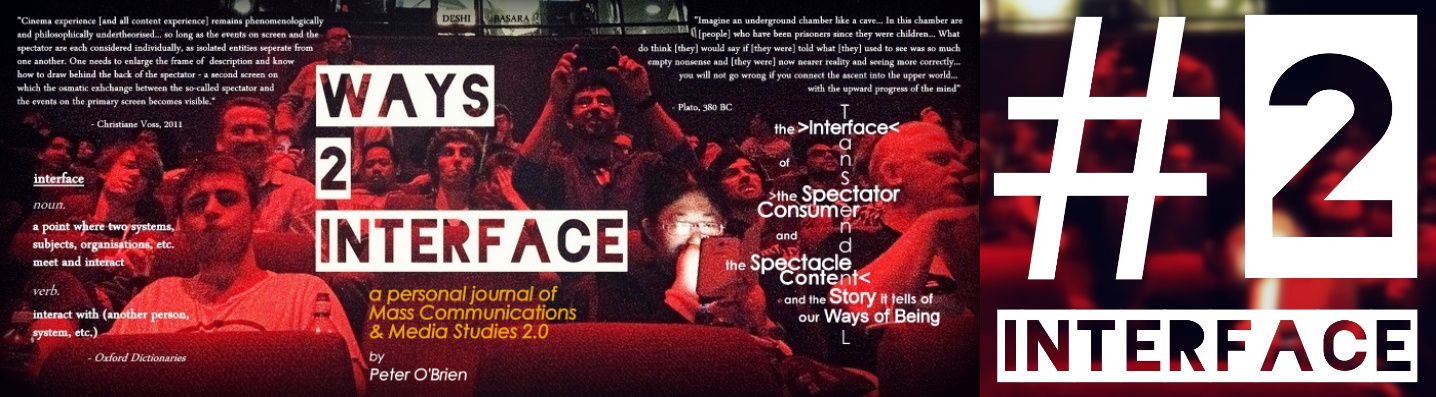
“cinematic experience [and all content experience] remain phenomenolgically and philosophically undertheorized, in my view, so long as the events on-screen and the spectator are each considered individually, as isolated entities separate from one another. One needs to enlarge the frame of description and know how to draw – behind the back of the spectator, so to speak – a second screen on which the osmotic exchange between the so-called spectator and the events on the primary screen becomes visible.”
– Christiane Voss, Film Experience and the Formation of Illusion, 2011:139
The truth of the spectator and the spectacle is not the spectator and the spectacle, the truth of the spectator and the spectacle is:
The-spectator-and-the-spectacle (or the-perceiving-participator-and-the-spectacle-experiencing-situation)
They are always a connected unit, the inputs and direct considerations of that unit are always in flux, but the basic unit always remains – it is a fundamental subjective gravity of our cognition.
The fallacy of Ways of Being, in regards to my dissection of the relationship of the spectator and the spectacle, is in the way that I discuss them as being what are fundamentally separate entities and only becoming combined as a result of an external interface – The device that exhibits the spectacle and allows the spectator access to it.
When we talk of the spectator and the spectacle in this separated fashion, we are getting a step ahead of ourselves.
In order to understand the relationship of the spectator and the spectacle, we need to take a step back and examine the nature of the fundamental internal cognitive process that makes the spectator and the spectacle, as separations, a reality.
This process is the internal interface – The cognitive interface inside every human mind.

The interface is what Christiane Voss is talking about when talks about a second screen behind the back of the spectator: “on which the osmotic exchange between the so-called spectator and the events on the primary screen becomes visible.”
The interface is the central focus of Ways 2 Interface because it offers the best means to reconceive of the spectator and the spectacle as fundamentally not being separate entities and to explore the internal workings of that combined entity.
I am not the first to talk about the interface in this way, but since the very recent all-pervasive overload of technological interfaces onto the consumer market there seems to be a growing consideration towards the larger conceptual frameworks the interface can offer us:
“our perceptions constitute a species-specific user interface that guides behavior in a niche. Just as the icons of a PC’s interface hide the complexity of the computer, so our perceptions usefully hide the complexity of the world, and guide adaptive behavior. This interface theory of perception offers a framework, motivated by evolution, to guide research in object categorization. This framework informs a new class of evolutionary games, called interface games, in which pithy perceptions often drive true perceptions to extinction”
– Donald D. Hoffman, The Interface Theory of Perception, 2009:1
Of all the interface considerations, Hoffman’s Interface Theory of Perception offers us the best place or perspective from which to begin a re-conception of the spectator and the spectacle; not only because It gives my own thoughts on the subject a leg to stand on, but because the computer simulation data he has already demonstrated that his theory holds some ground.
“Why all this horsepower in the brain just to look? The idea from Cognitive Neuroscience is that perception, vision is really just a reality engine; in real time you’re creating all the depths, colours, motions, shapes, textures and objects that you see, so you are creating the reality that you experience right now. You’re not just taking a snapshot of a world that was already there.”
– Donald D. Hoffman, 2013.
In presentation below Hoffman outlines his Interface Theory of Perception and how is impacts our conception of consciousness. You can read more of his research here.
“We pay good money for user interfaces because we don’t want to deal with the over-whelming complexity of software and hardware in a PC. A user interface that slavishly reconstructed all the diodes, resistors, voltages and magnetic fields in the computer would probably not be a best seller. The user interface is there to facilitate our interactions with the computer by hiding its causal and structural complexity, and by displaying useful information in a format that is tailored to our species projects, such as painting or writing.”
– Donald D. Hoffman, The Interface Theory of Perception, 2009:11
However, this is not to say that there is not a world external to us, Hoffman’s theory is just saying that we have evolved to see that world according to our species specific interface framework.
The interfacing relationship relationship between the-perceiving-participator-and-the-spectacle-experiencing-situation and the interface framework that would reveal is what the posts on Ways 2 Interface were going to theorize about.
I also planned to use the blog to document related research of other practitioners that I would pull apart and attempt to apply to my own theorizing.
Then, eventually, my plan was to take all the thinking collected on the Ways 2 Interface blog and apply it to a full-fledge research project as part of a fully accredited master’s degree.
My thinking was to build on the non-empirical research of Ways of Being and Ways 2 Interface by conducting first hand empirical research in an attempt to prove my theories on the interface.
I was very keen to take my media-centric research and explore it more broadly through the fields of cognitive psychology and neuroscience.
But I ultimately elected to pursue the equally difficult task of building my own master’s degree from scratch.
However, my thinking and theorizing regarding the the interface can be discerned in the first set of blog posts I wrote for the Ways 2 Interface blog, some of which were unfinished and have only recently been posted.
Just note, I haven't bothered to polish the unfinished posts, they have just been posted up in their original unfinished and unproofread forms...


