Showing posts with label Emerging Technologies. Show all posts

Thursday, 13 August 2015

Emerging Technologies & Career Success: Expanding my Entrepreneurship Specialization


The entrepreneurship specialization sequence of courses I have been studying on the Coursera platform since December 2014 I consider to be representative of the three courses + one capstone that form the specialization in addition to the further self-directed entrepreneurial studies, research and practice I have been doing around it. 

I have previously described this self-directed study as being equivalent to undertaking a traditional masters course and I certainly see my current learning program as fulfilling the function of the MSc in Creative Technologies and Enterprise I had initially planned to undertake (before coming to my logical senses). 

However, being an online entity that is constantly growing and something that I can very freely mix and match, my online studies are never a fixed and pre-determined course of study, as the ongoing evolution of the research and study blog over the past two year-and-a-half has shown.

Certainly, this is one of the great redeeming features about online learning - the student can take a much or as little time they feel is necessary in order to come to terms with as many or as few disciplines they feel the success of their end goal(s) requires. 

To this end, I have added to two further Coursera Specialization course sequences to my self-directed study portfolio:

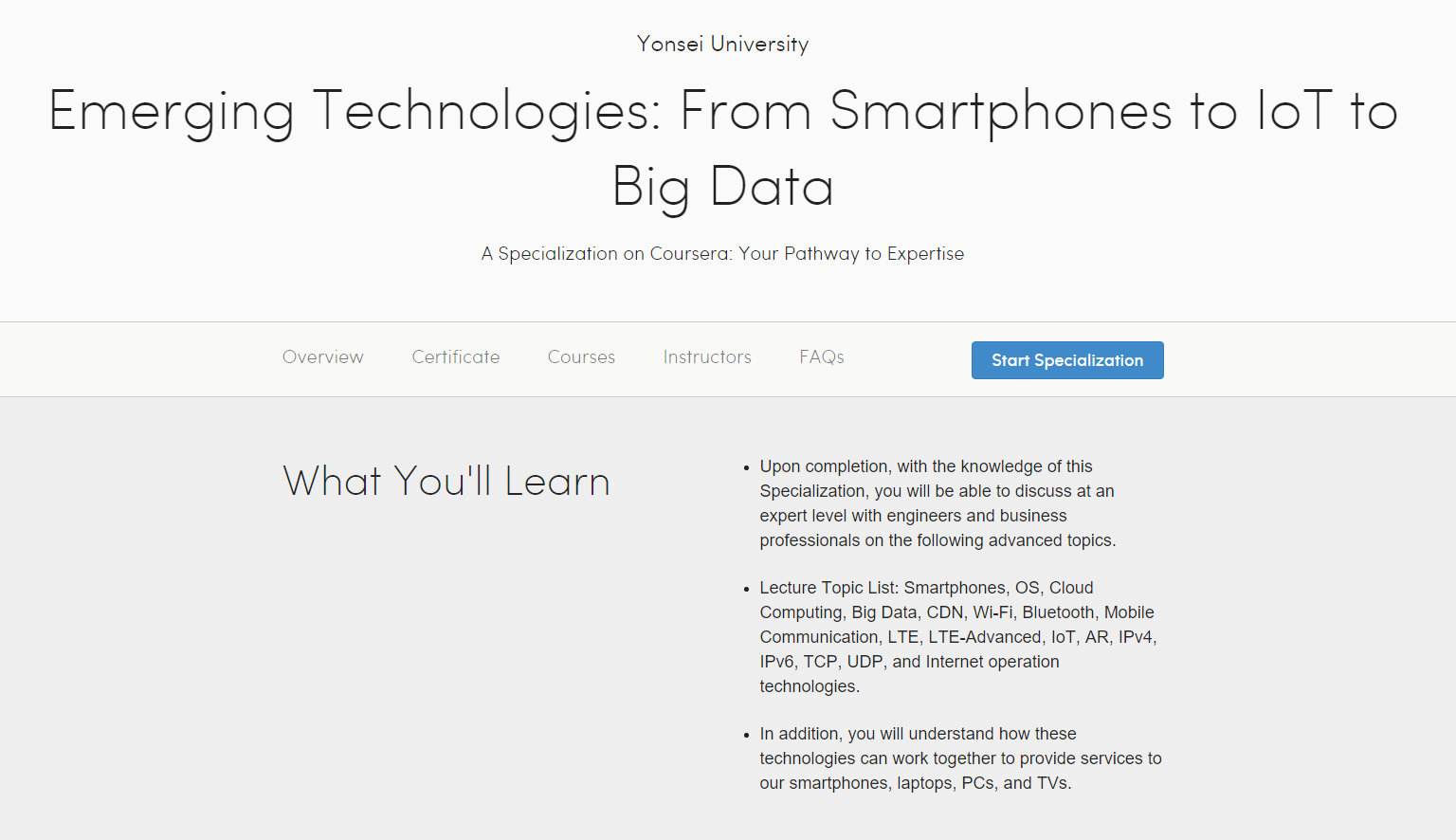
Emerging Technologies: From Smartphone to IOT to Big Data

As offered by Yonsei University and composed of the following courses:

  1. Smartphone Emerging Technologies - done
  2. Big Data, Cloud Computing & CND Emerging Technologies - done
  3. Internet Emerging Technologies - doing
  4. Internet of Things & Augment Reality Emerging Technologies - to-do
  5. Wireless Communication Emerging Technologies - to-do
  6. Emerging Technologies Capstone - to-do
Emerging Technologies: From Smartphones to IoT to Big Data

Career Success


As offered by the University of California Irvine and composed of the following courses:
  1. Project Management: The Basics for Success - doing
  2. Work Smarter, Not Harder: Time Management for Personal and Professional Productivity - done
  3. Finance for Non-Financial Professionals - done
  4. Communication in the 21st Century Workplace - done
  5. High-Impact Business Writing - to-do
  6. The Art of Negotiation - to-do
  7. Fundamentals of Management - done
  8. Effective-Problem Solving and Decision-Making - done
  9. Essentials of Entrepreneurship: Thinking & Action - doing
  10. Career Success Capstone Project - to-do


Career Success


I have decided to commit to completing these two further specializations, because:

  1. They further adhere my self-directed program of study closer to the one I would have undertaken in my MSc in Creative Technologies and Enterprise, emerging Technologies was a major component of the MSc.
  2. Emerging Technologies in relation to the skill-centric focus of the Career Success specialization greatly enriches my overall program of study to the point where it is actually become a superior program of study to the one offered in the MSc in Creative Technologies and Enterprise.
  3. The courses within each specialization are self-paced, so I can very easily spread the workload around my other commitments.
  4. The courses within each specialization are incredibly short, so I can very easily complete each course component in a relatively short space of time (I am already well over half through both specializations), which is useful considering I want to get the specializations done by the end of September.
  5. Exploitation of emerging technologies and updated career success skills are essential for future success in entrepreneurship. The business idea I am developing within my entrepreneurship specialization also relies very heavily on the focuses of emerging technologies and career success skills.
Between them, they will cost just over £600 but I am thinking of the long-term value the successful completion of these specializations will bring to my larger postgraduate portfolio. 

Furthermore, there is an additional self-paced and incredibly thorough Digital Marketing specialization (that is itself one module of a larger online MBA) I have been seduced by and plan to undertake once I have my Emerging Technologies and Career Success specializations out of the way.

As with emerging technology and career success skills, competitive exploitation and implementation of digital marketing practice is absolutely essential for entrepreneurial success! I have been looking for a decent and thorough online digital marketing course for over a year now (I was always confident a new one would pop up at some point) and FINALLY I have found it.

But digital marketing is not the current focus, emerging technologies and career success with entrepreneurship is.

Ultimately, when all is said and done, I can see now that all of my self-directed postgraduate study will be collected together on this Ways 2 Interface website as one cohesive portfolio with various specializations and discipline concerns outlined and detailed within, opposed to just one very expensive single piece of paper that students typically like to think proves they are fully capable and competent in their respected studied disciplines.

However, as our changing times are increasingly showing, this is proving to be more and more not the case. 

Tuesday, 17 February 2015

Finance and Film: New MOOCs


My latest MOOC additions...


University of Maryland on Coursera, 01/12/2014 - present

I have now started the third course in my entrepreneurship specialisation.

Funding for Entrepreneurs - syllabus


Finance is rarely ever an enjoyable subject, but it is an essential one and one that I am fully determined to master!


Wesleyan University, 02/02/2015 - present

This MOOC is more of a side curiosity and really is just exploring a subject I have always been fascinated by in the world of cinema - innovation.


Additionally, I get to watch a number of films as part of the course which is always a plus.


University of Copenhagen, 02/02/2015 - present

Another side curiosity which I am not bothering to study too minutely, I am just using the course materials in order to provide an overview of Scandinavian cinema.

Scandinavian Film and Television - Syllabus


However, I do wish that I did have the time to study it a little more closely, but I will more than likely sign up for an additional session of this MOOC later in the year.


National Film and Television School, 02/02/2015 - present

I am not really studying this MOOC as much as I am reviewing it to determine how it teaches the various facets of filmmaking in the online space.


However, it has been refreshing many of the pieces of knowledge and practice I gained from my BA (hons) in Creative Writing with Film and Screen Studies. Knowledge that is currently being put into practice in my 365 FRAMES 2015 project.


Universidad Carlos III de Madrid, 17/02/2015 - present

This MOOC caught my eye some time back and is one that I have been eagerly awaiting to undertake; mainly because it picks up where my traditional education in documentary left off and considers a subject that is at the heart of the Ways 2 Interface research project and study log - the ways in which we interface with ourselves.


Additionally, this MOOC deals with a progressive area that I am currently exploring in my 365 FRAMES 2015 project; as well as various other creative projects I am developing.


Friday, 19 December 2014

Classrooms and Technology - Understanding Language - weeks 2&3 reflection #FLlanguage #MOOC


I believe that the current expansion into online learning is starting to change this and all these online MOOCs offer additional study resources for students and educators to exploit. I believe there now needs to be a greater cohesion between face-to-face learning and online learning programs, as both offer merits that supports the other. Knowledge is great, but the human being evolved as a result of being a social animal.


I have bundled weeks 2 and 3 of the Understanding Language MOOC together because they are really two sides of the same coin. 

Week 2: Language Teaching in the Classroom deals with traditional classroom based methods of teaching language

and

Week 3: Technology in Language Learning and Teaching deals with progressive forms of language acquisition and it's tutelage in today's digital focused world.

This reflection will be a short one mainly because I drew far less from weeks 2 and 3. The content of weeks 2 and 3 was not a poor quality, but rather it was mostly material that I had covered previous and from my point of view is pretty common sense.


 Week 2: Language Teaching in the Classroom 


The main emphasis of week 2 is on the classroom, the 'community' therein and how the construction of this collaborative community and the relationship between educators and students is intricately important in the acquisition of new languages.

A key point that is made is the difference between naturalist and classroom teaching which is to say that there exists a huge difference between learning a language in a classroom setting opposed to acquiring it by immersing yourself in the everyday culture for which the language you are learning is utilised. 

A classroom is a community of practice.


In addition to using the classroom setting to break down a language to it's conceptual foundations, the real challenge for language educators is to structure their programs of study in such a way as to also stimulate naturalists/spontaneous language exchange within in the classroom and its culture of students: 

"in the 1970s and '80s, we went through a phase of thinking that classrooms should really imitate naturalistic language learning, and classrooms should be imitating first language learning. I think research in recent decades has told us that that's too simple a story, that classroom learning is a more complex business than that. Yes indeed, classrooms need to provide input, and need to provide a focus on meaning, and on learners making their own meanings, but classrooms also need to provide other things. First of all, it's been shown clearly that classrooms can help learners by actually developing their conceptual understanding of language, giving them key ideas that will help them make sense of the structure of the new language."  
- Professor Rosamund Mitchell, Understanding Language educator

Unfortunately, I am not really interested in teaching language learning, only in learning a language and most of week 2's content was aimed at language educators. 

The above point about the different between naturalist and classroom was not the only main point of the second week, but it is the only thing I have really taken from it - knowledge and experiential acquisition is not all done within the classroom, BUT the classroom can still help a great deal.

As ever, it's case of the best learning is done as a 50/50 split between practical and theoretical practice - something I learned while undertaking my undergraduate degree and presented as a welcome reminder here!

Certainly, I will be bearing this in mind when I do learn a language, whatever that language ends up being...


 Week 3: Technology in Language Learning and Teaching 

Week 3 of the Understanding Language MOOC was centered around the conceptual explorations of language learning in the digital classroom. A great deal of consideration was directed towards the differences between face to face learning and online learning and what makes an effective online educator. 


The basic success requirements of online learning.


As this blog will testify, I am big on digital and online learning, as I have already gained a great deal from it and I can see that it has ongoing potential that has yet to be fully tapped into, as I said in the comments section of week 3:

"This is my 36th online course and I have used various different online learning platforms. Overall, I have found it be a vastly more rewarding experience compared to face-to-face learning. The flexibility and choice online learning offers you means that you can tailor your learning to meet the requirements of your own personal development criteria. 

When I was at university, while I did adhere to the taught program of study, I found myself branching off to seek out other areas of learning that my degree program was not fulfilling, such as basic life and career skills that would enable me to actually utilise my degree when I graduated! This is a common complaint among students and academia seems to think it is okay to exist in a bubble that is far removed from reality. 

I believe that the current expansion into online learning is starting to change this and all these online MOOCs offer additional study resources for students and educators to exploit. I believe there now needs to be a greater cohesion between face-to-face learning and online learning programs, as both offer merits that supports the other. 

Knowledge is great, but the human being evolved as a result of being a social animal." 

This social aspect was touched on briefly at the end of week 3 in the MOOC's consideration of connectivist learning.

Connectivist learning - I'm doing it with this blog!


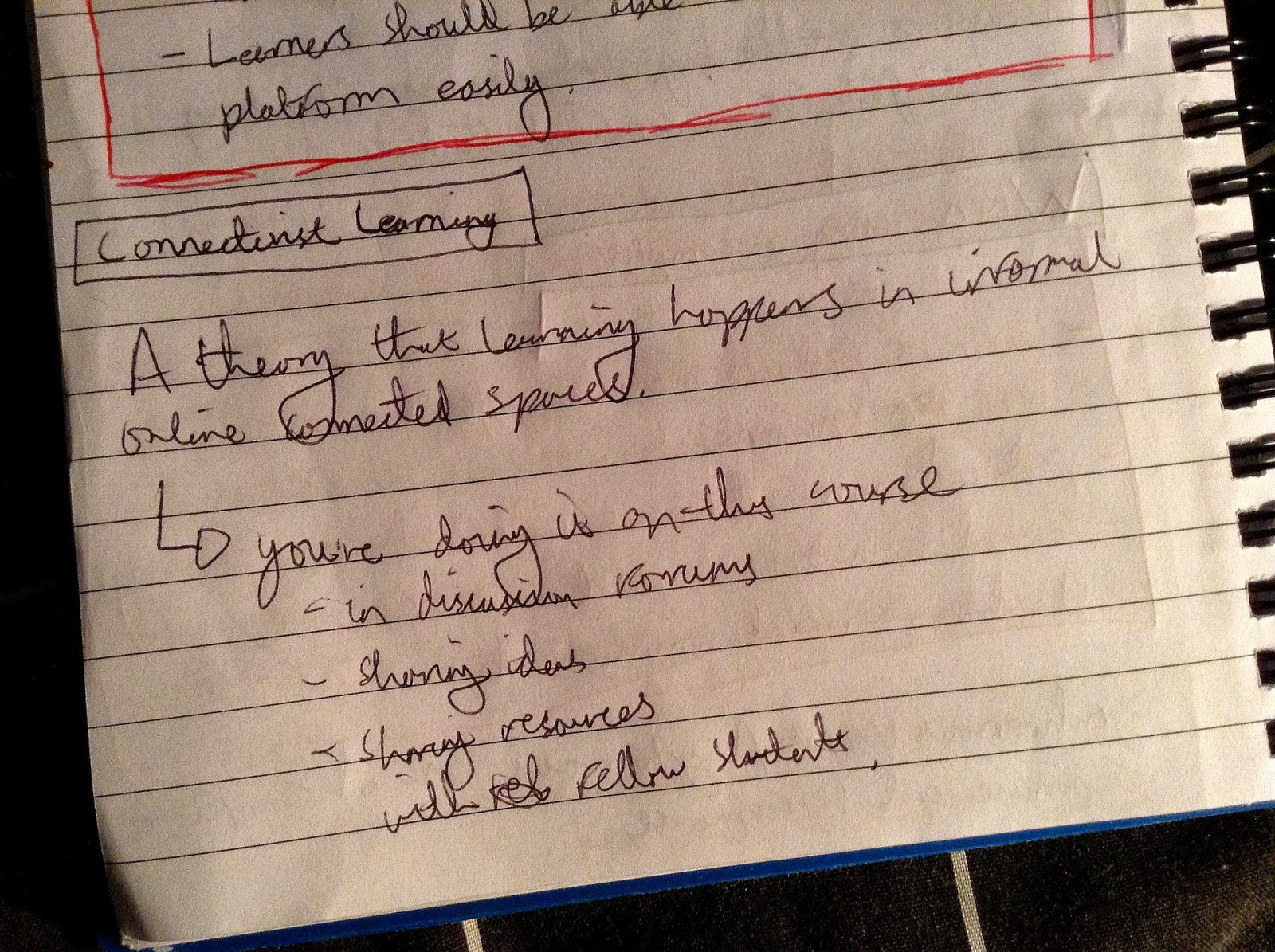
Connectivist learning  basically refers to the sharing of informative resources and discussions via discussion forums, social networks, etc., and certainly with something like language acquisition, conducting in this connectivist on an international cyberspace, the usefulness of connectivist interactions in language learning should be plain.

However, as with the second week, the third week was mainly geared towards the students who aim to go and teach language, either in the classroom or online. OR, as I pointed out, to teach language vastly more effectively by utilising a combination of classroom and online teaching.  

Ultimately, what these two weeks taught me is that if I do eventually learn a new language, then the process of learning I should employ is the process of learning I am already utilising. 

Monday, 1 December 2014

The web is not an exact science - Web Science - week 1 reflection #FLwebsci #MOOC


Web Science is inherently transdisciplinary as it is employs many analytical techniques and knowledge bases from other subjects, such as economics, law, psychology, sociology, computer science, etc., hence why I am drawn so much to this subject. The aim is for Web Science to operate very much outside of the box in order to consider the thing we have come to call the web - a thing that keeps growing, that keeps changing and that is anything but an exact science!


Back in February I started the Web Science MOOC as presented by the University of Southampton on FutureLearn, but I struggled to find a way into sticking with the essential focus of its topic. 

What is Web Science?


The main problem was that I lacked a technological foundational understanding in how the web actually works on a software and hardware basis. Therefore, after completing the first-and-a-half weeks, I decided that I would come back to the MOOC at a later date, once I possessed a better foundational understanding.

One of the great things about many MOOC platforms is that they let you retain access to the course materials long after the course has completed.


However, now that I have dabbled a little with coding and have (nearly) finished the Internet History, Technology and Security MOOC, I now possess a basic understanding of the operational processes behind the internet. 

Additionally, while I was undertaking the Internet History, etc. MOOC and also its kindred Introduction to Cyber Security MOOC, I noticed that my attention kept shifting back to this Web Science MOOC.

As I was coming to understand the workings of the internet, I noticed that I started to look at my daily usage of the internet in a very different way: a very analytical manner not too dissimilar to the perspective the Web Science MOOC had started to nurture in me...


Web Science - an introduction to a bold new academic discipline.

Web Science is inherently transdisciplinary as it is employs many analytical techniques and knowledge bases from other subjects, such as economics, law, psychology, sociology, computer science, etc., hence why I am drawn so much to this subject. The aim is for Web Science to operate very much outside of the box in order to consider the thing we have come to call the web - a thing that keeps growing, that keeps changing and that is anything but an exact science!

The tangled pre-history of the web.


Week 1 of the MOOC provides a brief pre-history and and recent history of the web and this is something that Internet History, etc. has gone into vastly more detail and is accordingly vastly more enlightening. 


Tim Berners-Lee is where the 'web' begins, he is not where the 'internet' begins.


I believe this lack of in-depth consideration of the various phases of the webs history is where I felt really let down and unclear about when I first undertook the MOOC back in February. 

However, I can not really blame the course as it is called 'web science', not 'internet science' and, therefore, is not concerned with the web's precursor before Tim Berners-Lee's proposal for the World Wide Web in 1989 (also the year I was born). Obviously you will need to possess some historical background context for this subject, but for a short course offering, such as this MOOC, you can only expect it to cover so much.

Ultimately, the aim of this short course MOOC is to supply you with the basic tools in order to encourage you to proactively think much more analytically about the web, how it is changing the world and what role you have to play in this new technology. 

One of the best ways in which the MOOC achieves this in week 1 is in its consideration of technological determinism and in questioning its position that technology is shaped by society in social construction.


Does technology shape society or does society shape technology?


The argument for and against technological determinism was something that was heavily touched upon in the E-Learning and Digital Cultures MOOC I undertook previously. While the concept of technological determinism was introduced to me I did not really grapple with its larger implications.


E-Learning and Digital Cultures was not a MOOC with which I really thoroughly stuck.


Additionally, technological determinism is not something that was really dealt with in my Film and Screen Studies BA (Hons) either, as technological determinism is something that is more integral in Media Communications concerns. 

However, while it was never the primary agenda, technological determinism can be seen to have a part to play in my theoretical dissertation Ways of Being: The Spectator and the Spectacleessentially that the new technologies of cinema were arising out of a consumer demand for bigger film experience immersion. 

Therefore, my view is very much in favour of social construction, not technological determinism, and this is the same view that the Web Science MOOC adopts.


Why is a discipline such as Web Science is so integral?


"There are some bits of technological determinism that work. Certainly, the kind of technology in the Web, its openness, its democratic features, those things shape how the Web is. But there are other things which are very much part how we, as human actors and agents and societies, take that technology and do all sorts of different things with it, things that Tim Berners-Lee couldn't even have imagined, so Facebook or Twitter, for example" 
- Catherine Pope, Web Science educator.

Technology does not just change us, it is much more about us influencing technology - the web is a major and direct example of this. 


Social shaping vs. technological determinism - which do you support?

On the whole, social shaping has become the dominant view and the web in particular is a primary example of how society shapes new technologies to fit the needs of society:


"The state of the market, or better, of society is the crucial factor in enabling the development and diffusion of any communications technology or in hindering it. That is as true of the computer chip and the Internet as it was of the telegraph and the telephone. Thus, innovations are the creatures of society in a general sense." 
- Brian Winston, Technologies of Seeing, 1996:3.
This is why the further development of a discipline like Web Science is so strongly advocated and needed. 

Certainly, in terms of Film and Media disciplines, this is what I was getting at in Ways of Being


"In short, there is too much indifference in Film Studies.The discipline is too focused on cave-like thinking and film theory of the past; a pantheon of knowledge that is becoming continuously outdated and finding itself at odds with new advancements and diversifications, such as the digital re-birth and large format hypercinema. Film scholars have always sought to understand the spectator’s and spectacle’s mutual pursuit of enlightenment; while they have uncovered aspects of it, there still does not exist a single unifying explanation of the profound processes of that relationship" 
- Ways of Being, 2013:105.

However, while my focus may have been towards Film and Media disciplines, by not considering the networking-and-interactions of these technologies and processes is insane and this is very much the incentive behind creating Ways 2 Interface.


Some notes I made while planning out Ways 2 Interface.


I have created Ways 2 Interface as a web blog precisely because it is considering the relationship of the spectator and the spectacle in film and media as connected globally in the thing we have called the web - it is analysing the the very thing of which it is a part. 

"Everything that has been presented throughout this paper is representative of the shift in thinking that is slowly taking place alongside the digitalisation of cinema and needs to continue to take place! In moving away from the cave, we have stopped viewing spectacle content on a screen, and we now experience and interact with it via an interface. If there is a great deal of neurobiological participation happening on the spectator’s part, then perhaps this offers a more accurate way to talk about the process by which the spectator interfaces with any type of film spectacle. While this section can not hope to provide many answers to the questions it has raised, one obvious conclusion should be apparent - all these diverging means of experiencing the world will continue to have huge implications on our ways of being in the world"
- Ways of Being, 2013:151.

Ultimately, the web has adopted cinema into its paradigm and this is the reason for why I am so fascinated by the web - it's a direct and vastly intricate expression of the relationship of the spectator and the spectacle like we have never seen before!

Certainly, Web Science will be huge help and an additional component of this transdisciplinary consideration I have taken up.

Is the web guaranteed to exists indefinitely? 

I am currently undertaking quite a few MOOCs (as always) and while I do plan to finally work my through and finish the Web Science MOOC, it may not be any time soon, I will be engaging with the MOOC materials whenever I can make the time for them.

However, I do not think that making time will be a problem as it is clear that the knowledge this MOOC will nurture in me will have a clear and primary role to play in my further studies and research interests.


The web a.k.a. unlimited potential. We have barely scratched the surface. 


The web is for everyone and for everything, but it is not an exact science, it is something that we have to keep working at in regards to how we further develop it and how we continue to analyse it.

That's Web Science.