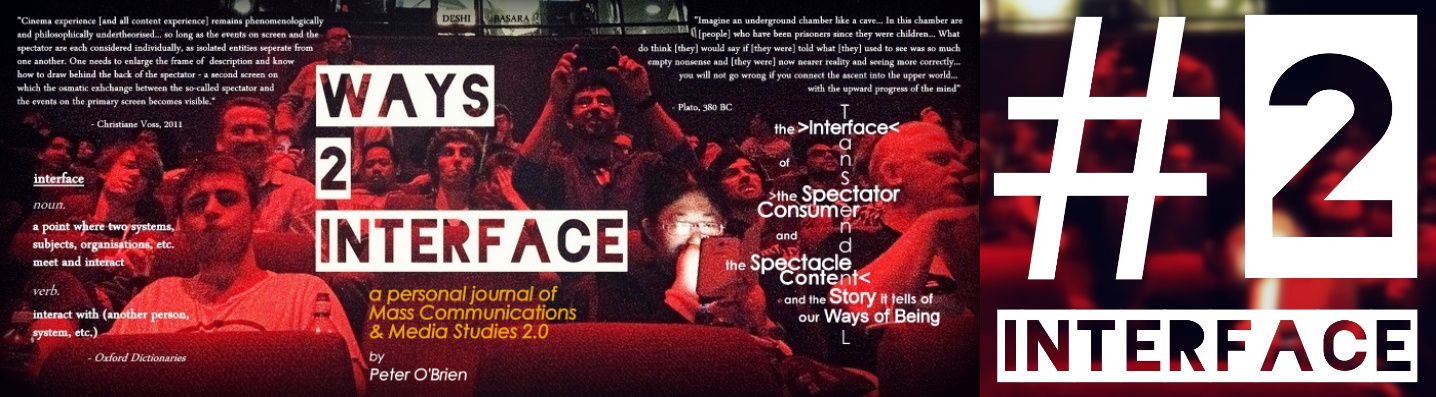
Showing posts with label Ways of Being. Show all posts

Monday, 29 July 2024

The Fundamental Focus of Ways 2 Interface

“We watch films with our eyes and ears, but we experience films with our minds and bodies. Films do things to us, but we also do things with them. A film pulls a surprise; we jump. It sets up scenes; we follow them. It plants hints; we remember them. It prompts us to feel emotions”
– David Bordwell, The Viewer’s Share: The Model of Mind in Explaining Film, 2012

The point of Ways of Being: The Spectator and the Spectacle was to open up the relationship the spectator has with the spectacle and show that it is much more nuanced than merely the spectator passively taking in the spectacle.

“we need to understand how the spectator views, absorbs, receives, engages, experiences, constructs, desires, negotiates, manipulates, participates, fantasises, debates, infers, identifies, critiques, addresses, senses, recreates and integrates with the cinematic fiction [spectacle].”
Ways of Being: The Spectator and the Spectacle, 2013:36

This is why in Appendix A of the paper, I started to put together redefinitions of the spectator and the spectacle to better express their complex interactions.

What I came up with was…The spectator redefined as the perceiving participator
The spectacle redefined as the spectacle experiencing situation

But, again, something was missing because the perceiving participator and the spectacle experiencing situation were not providing a fully accurate description because, like the spectator and the spectacle terms, they were treating this combined relationship as being made up of two fundamental separated entities:

“cinematic experience [and all content experience] remain phenomenolgically and philosophically undertheorized, in my view, so long as the events on-screen and the spectator are each considered individually, as isolated entities separate from one another. One needs to enlarge the frame of description and know how to draw – behind the back of the spectator, so to speak – a second screen on which the osmotic exchange between the so-called spectator and the events on the primary screen becomes visible.”
– Christiane Voss, Film Experience and the Formation of Illusion, 2011:139

The truth of the spectator and the spectacle is not the spectator and the spectacle, the truth of the spectator and the spectacle is:

The-spectator-and-the-spectacle (or the-perceiving-participator-and-the-spectacle-experiencing-situation)

They are always a connected unit, the inputs and direct considerations of that unit are always in flux, but the basic unit always remains – it is a fundamental subjective gravity of our cognition.

The fallacy of Ways of Being, in regards to my dissection of the relationship of the spectator and the spectacle, is in the way that I discuss them as being what are fundamentally separate entities and only becoming combined as a result of an external interface – The device that exhibits the spectacle and allows the spectator access to it.

When we talk of the spectator and the spectacle in this separated fashion, we are getting a step ahead of ourselves.

In order to understand the relationship of the spectator and the spectacle, we need to take a step back and examine the nature of the fundamental internal cognitive process that makes the spectator and the spectacle, as separations, a reality.

This process is the internal interface – The cognitive interface inside every human mind.

The interface is what Christiane Voss is talking about when talks about a second screen behind the back of the spectator: “on which the osmotic exchange between the so-called spectator and the events on the primary screen becomes visible.”

The interface is the central focus of Ways 2 Interface because it offers the best means to reconceive of the spectator and the spectacle as fundamentally not being separate entities and to explore the internal workings of that combined entity.

I am not the first to talk about the interface in this way, but since the very recent all-pervasive overload of technological interfaces onto the consumer market there seems to be a growing consideration towards the larger conceptual frameworks the interface can offer us:

“our perceptions constitute a species-specific user interface that guides behavior in a niche. Just as the icons of a PC’s interface hide the complexity of the computer, so our perceptions usefully hide the complexity of the world, and guide adaptive behavior. This interface theory of perception offers a framework, motivated by evolution, to guide research in object categorization. This framework informs a new class of evolutionary games, called interface games, in which pithy perceptions often drive true perceptions to extinction”
– Donald D. Hoffman, The Interface Theory of Perception, 2009:1

Of all the interface considerations, Hoffman’s Interface Theory of Perception offers us the best place or perspective from which to begin a re-conception of the spectator and the spectacle; not only because It gives my own thoughts on the subject a leg to stand on, but because the computer simulation data he has already demonstrated that his theory holds some ground.
“Why all this horsepower in the brain just to look? The idea from Cognitive Neuroscience is that perception, vision is really just a reality engine; in real time you’re creating all the depths, colours, motions, shapes, textures and objects that you see, so you are creating the reality that you experience right now. You’re not just taking a snapshot of a world that was already there.”
– Donald D. Hoffman, 2013.

In presentation below Hoffman outlines his Interface Theory of Perception and how is impacts our conception of consciousness. You can read more of his research here.

“We pay good money for user interfaces because we don’t want to deal with the over-whelming complexity of software and hardware in a PC. A user interface that slavishly reconstructed all the diodes, resistors, voltages and magnetic fields in the computer would probably not be a best seller. The user interface is there to facilitate our interactions with the computer by hiding its causal and structural complexity, and by displaying useful information in a format that is tailored to our species projects, such as painting or writing.”
– Donald D. Hoffman, The Interface Theory of Perception, 2009:11

However, this is not to say that there is not a world external to us, Hoffman’s theory is just saying that we have evolved to see that world according to our species specific interface framework.

The interfacing relationship relationship between the-perceiving-participator-and-the-spectacle-experiencing-situation and the interface framework that would reveal is what the posts on Ways 2 Interface were going to theorize about.

I also planned to use the blog to document related research of other practitioners that I would pull apart and attempt to apply to my own theorizing.

Then, eventually, my plan was to take all the thinking collected on the Ways 2 Interface blog and apply it to a full-fledge research project as part of a fully accredited master’s degree.

My thinking was to build on the non-empirical research of Ways of Being and Ways 2 Interface by conducting first hand empirical research in an attempt to prove my theories on the interface.

I was very keen to take my media-centric research and explore it more broadly through the fields of cognitive psychology and neuroscience.

But I ultimately elected to pursue the equally difficult task of building my own master’s degree from scratch.

However, my thinking and theorizing regarding the the interface can be discerned in the first set of blog posts I wrote for the Ways 2 Interface blog, some of which were unfinished and have only recently been posted.

Just note, I haven't bothered to polish the unfinished posts, they have just been posted up in their original unfinished and unproofread forms...


The Master's Degree Behind Ways 2 Interface

Ways of Being: The Spectator and the Spectacle, the theoretical dissertation I completed for my BA (Hons), was a big deal.

It was a big deal for me personally because it was a breakthrough in terms of my skill as a researcher and writer.

But it was a big deal academically too because it was a 30,000 word thesis that received the highest mark of my graduating year and was also bestowed with a research excellence award.

I had put a lot of work into and had planned to achieve a solid first from it, but I had never envisioned attaining the result I ultimately did achieve with it.

The success I achieved with Ways of Being came as a huge surprise and it opened a lot of doors; particularly regarding the undertaking of a master’s degree, which was something I had not previously given serious thought towards.

Ways of Being was a consideration of the epistemological, ontological and metaphysical downfalls of film theory’s understandings of the spectator and the spectacle; with particular emphasis directed towards the neurobiological implications of the spectator’s body.

The research focus of Ways of Being was something that I was passionately interested in and which I had only scratched the surface of within the submitted thesis paper.

There were a great deal of loose ends, both in the main body of the work and also in the appendices, that I really wanted to continue further.

In particular, Appendices A, F and I (which had once been the basis of another chapter in the main body) were two of the key sources of continuation.
I couldn't squeeze Chapter 3 into the limited word count of the main body, so it ended up becoming Appendices F and I
Ultimately, Ways of Being and its success ended up becoming the main driving for behind undertaking a master’s degree; with the potential of undertaking a PhD further down the line.

But deciding what master’s degree I wanted to pursue and how I was going to fund it took a very long time for me to figure out.

In the meantime, I decided to keep my research focus active and created the Ways 2 Interface blog where I could record my latest findings and theorizations.

As much as Ways 2 Interface was a continuation of my theoretical dissertation, it was also a continuation of my practical dissertation, EYES.

EYES was a web series concept proposal package that was a reflexive expression of contemporary networking attitudes and their implications on our ways of being.

The proposal package included a produced pilot episode, a series bible and a producer’s planning portfolio document.

The package also included a blog, EYES of a Storyteller, that I used to chronical the development of the project and Ways 2 Interface very continues in the same vein of its loose and transdisciplinary blogging style.

Ultimately, while I didn’t end up continuing my research in a traditional master’s degree, Ways 2 Interface did serve much the same bridging purpose between my BA (Hons) and the creation of my MTA Portfolio.

The curriculum of the traditional master’s degree I had planned on undertaking, Creative Technologies and Enterprise, but ultimately abandoned was also absorbed into the makeup of my MTA Portfolio.

Ways 2 Interface had a huge part to play in to create of my MTA concentration in Multimedia Studies and Creative Technologies and, for a time, very much serves as an adjunct blog to it.

Friday, 22 January 2016

Ways of Being - the primary progenitor for Ways 2 Interface


Ways of Being: The Spectator and the Spectacle is my award-winning graduate theoretical dissertation, that is itself the culmination of a seven month research project. 

As the name suggests, Ways of Being is the primary progenitor and the prelude for Ways 2 Interface.

The paper is devoted to Douglas Trumbull, for his innovating efforts, inspiring persistence and words of wisdom


"The mark of 85 is an exceptional mark, rarely awarded, and only to work of exceptional quality. I am pleased to say that both examiners agreed that this was the case with your work."

- Dr Suman Ghosh, guiding tutor and primary marker.


The masters length paper was praised for its boldness, progressive thinking and received the highest mark that has ever been awarded to a Film and Screen Studies dissertation at Bath Spa University; as well as being awarded the Media Futures Research Award for Excellence in Film and Screen Studies research.


"This is certainly one of the best FL dissertations I have read for many a year."

 - Dr Terence Rodgers, Head of Department and second marker.


The paper is a consideration of the epistemological, ontological and metaphysical downfalls of film theory’s understandings of the spectator and the spectacle; with particular emphasis directed towards the neurobiological implications of the spectator’s body.

The thesis argues that these shortcomings are representative of wider ranging issues of complacency engulfing the film industry and film exhibition as a whole. Furthermore, the fundamental disruptions of the digital upgrade of cinema, and the expanding means through which film content can be experienced, are explored in relation to the pressing need for film theory to reassess itself.


Drawing on a plethora of empirical and non-empirical research, the dissertation is a highly progressive expression of how film experience has always been about transcendence and, as a result of its digital re-birth and diversifications, it is now becoming even more so. 
   

Other materials pertaining to this project can be viewed in this Google Drive folder.

On top of my other final year projects, getting the paper up to the standard I wanted was a tall and exhausting order, but it was worth it!

"This is a well researched, conceptually sound and cogently argued dissertation which is striking in its originality of argumentation and in its nuanced reading of a wide range of film and critical material.
It draws on a plethora of examples from traditions of visual culture from prehistoric cave art to contemporary film, the IMAX experience and future practices of audio‐visual consumption in order to examine traditional and contemporary theories of spectatorship and the spectator’s relation with the spectacle.
The introduction clearly sets out the structure and methodology of the dissertation and provides a useful overview of the technological shifts which have resulted in a reconfiguration of the relationship between the viewer and the viewed.
This is clearly an ambitious project.
It makes a passionate case for the revival of grand theory in studies of Spectatorship in particular and Film Studies in general and sustains this case through argumentation of an exceedingly high order.
It acknowledges the need to expand the scope of such studies beyond film, in its reference to a wide range of media texts as much as to critical literature, all of which are directed towards an understanding of spectatorship from points of view as diverse as the sensory, experiential, philosophical, spiritual, metaphysical and neurological."  

- Dr Suman Ghosh, Senior Lecturer in Film and Screen Studies.

  
As a result of my enthusiasm for the project, I unearthed so much data that the first draft I assembled warranted a request for a larger word count submission. As such, the primary content I eventually submitted totalled just fewer than 15,000 words, with the Appendix and other supplementary material bringing the overall word count to over 30,000 words! Furthermore, I still had additional ideas and data that would have allowed me to write more - hence my reasoning for orchestrating Ways 2 Interface.

One of two hard copies I submitted on 6th June 2013.

The copy of Ways of Being that is included here is a refined draft that I produced between July and September 2013. As it became apparent that the research project had attained a longevity greater than the paper itself, I decided that I would produce a polished draft to exhibit online; both with the aim of including it as an additional component of this website, but also as a dissertation example that other students could scrutinise. 


The research content and argumentation has not been altered or added to in anyway; rather, the refined draft includes additional polishing, proofing and initial page material. Key among this new initial page material is the marking feedback I received and a new Foreword section in which I reflect on and deconstruct my process of assembling the paper. 


If you would like to view the original submitted paper, then you can do so here.

The study of looking is a recurrent interest for me.Why? Search me...


Additionally, the Ways of Being research project had a huge influence on my EYES web series project and vice versa; in fact, I refer to EYES, my practical dissertation and creative enterprise project, as being the practical expression of what I explored in Ways of Being. I believe the high marks both projects were awarded - EYES was also awarded the highest mark of its module - stand as testament to their mutually beneficial relationship.