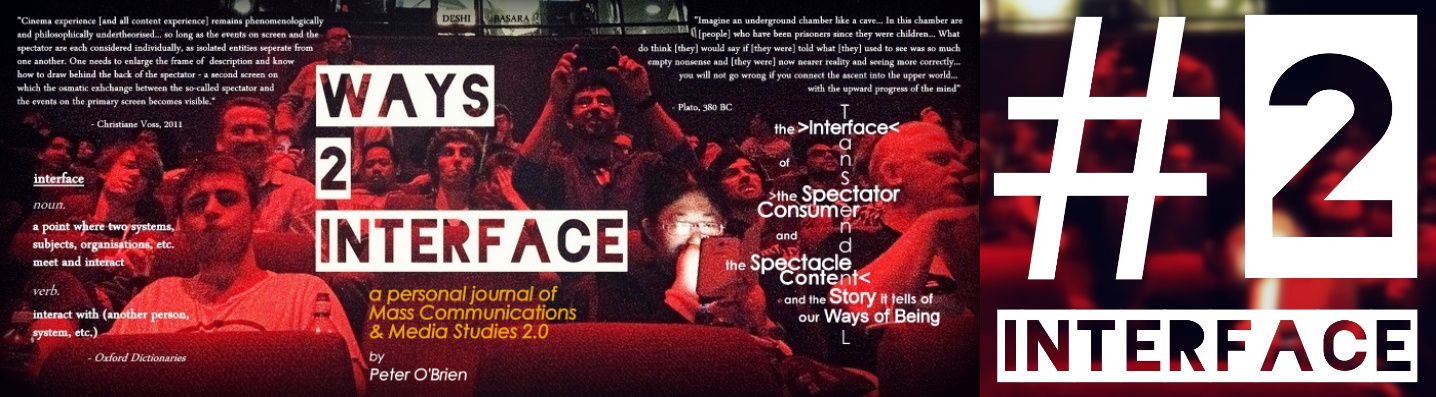
The following is an unfinished post from 2014 that was originally meant to be one of the introduction posts for the Ways 2 Interface research project, but I didn't end up using it.
I've published it now because it holds many pertinent points for why I undertook the Ways 2 Interface project in the first place.
I have not finished the post and it contains many errors and unfinished sections.
Unfinished Business: The Story of the Interface
From the cave wall to the Facebook wall, the interface of the spectator and the spectacle, a physical and cognitive intermingling of consumer and content, is a widespread manisfestation and an integral identity and reality constituting process, that quite literally tells the story of our universal and underlying ways of being.
Building on the award-winning research paper, 'Ways of Being: The Spectator and the Spectacle', in a continuing endeavour to reconceive the spectator and the spectacle as the-actual-being-within-and-perceived-being-without, 'Ways 2 Interface' is a progressively inclined transdisciplinary research project that explores the interface-cognitive-process - the-actual-being-within-and perceived-being-without - inherent to us all by examining the habits and manifestations of our cognitive, corporeal and cultural ways to interface.
We are the stories we tell ourselves, the key to understanding the purpose of the interfacing-process is in realising both the deciets of the abstractions in which we constantly immerse ourselves and the ways in which we constantly immerse ourselves in the truths of those abstract deceits. From the two million year odyssey of our intellectual growth, to our current plugged in transmedia and transhuman digital re-birth, 'Ways 2 Interface' covers a lot of ground in its endeavour to ascertain how the interfacing-process has always empowered our ways of being stories, while also speculating on the transcendence of where our networked narrative is going...
Ways 2 Give Yourself Many Splitting Headaches: A Whole New Vague Notion
Outlining this project in my head, in writing and in person has always been a nightmare (the outline above was done over three days) and this is why I have held of launching this website for the past three months. I did not want to officially launch this project until I had its focus completely nailed down. Saying that it was just a continuation of the research of its first manifestation was not enough; it was not enough because the considerations of the project had grown a great deal since submitting Ways of Being in June, 2013. The fundamental focus of the project has altered, it has become a whole new vague notion.
 | |
| "How we feel films" - the vague notion for Phase 1 |
The trick is to now turn this new vague notion into a logical and backed up argument. This is exactly the reason for why I have struggled to outline this project for so long, because it has been a vague notion buried within a plethora of differing areas of research. Up until now, if someone has asked me to explain the project, I have just told them about a particular aspect of it; the most popular being: "I am researching changing viewing habits," which I am, but that is not the full story. This project is a complex issue becasue it touches on so many different areas and disciplines.
Indeed, since submitting Ways of Being and continuing the research, the more research I do, the more the project grows and the more I have been lead to feel that I did not know what it was I was researching.
However,
while I have been redefining the project into its next phase over the
past few months, I have realised a more fundamental truth as to why
defining this project has always been something of a headache - I am
looking into the thing, that is looking into the thing.

If I am being honest, I have never been very good at outlining things before I start them; generally, I will just spend a lot of time making a big mess and then, eventually, make something from that mess. That is how Ways of Being came to be and that is how its successor has come to be, seven months of mess making later.
For the past three months I have been writing up its first batch of posts - the introduction batch - combined, I have about 30,000 words of material written up.
and spread across various posts, through which I have re-worked and re-thought this projects focus and, finally, I have arrived here at the actuall first introduction post where I will outline the essential focus of this project. Finally, Ways of Being has transcended fully into Ways 2 Interface.
and spread across various posts, through which I have re-worked and re-thought this projects focus and, finally, I have arrived here at the actuall first introduction post where I will outline the essential focus of this project. Finally, Ways of Being has transcended fully into Ways 2 Interface.
and one of the reasons I have decided to continue orchestrating this project, after I submitted its original manifestation as Ways of Being in June 2012, is basically so that I could refine its outline - I want to find out what exactly it is I have always been getting at in this project.
However,
on the course of forming this argument, I uncovered and correlated
various other considerations into the mix and this is where the project
really started to grow, so much so that the first draft of my paper came in at around 17,000 words, 7000 over the accepted word count. required word count of 10,000 words I hold no shame in
admitting the fact that I eventually submitted a Masters' length paper for my graduate degree.
"It draws on a plethora of examples from traditions of visual culture from prehistoric cave art to contemporary film, the IMAX experience and future practices of audio‐visual consumption in order to examine traditional and contemporary theories of spectatorship and the spectator’s relation with the spectacle.
The introduction clearly sets out the structure and methodology of the dissertation and provides a useful overview of the technological shifts which have resulted in a reconfiguration of the relationship between the viewer and the viewed.
This is clearly an ambitious project. It makes a passionate case for the revival of grand theory in studies of Spectatorship in particular and Film Studies in general and sustains this case through argumentation of an exceedingly high order.
It acknowledges the need to expand the scope of such studies beyond film, in its reference to a wide range of media texts as much as to critical literature, all of which are directed towards an understanding of spectatorship from points of view as diverse as the sensory, experiential, philosophical, spiritual, metaphysical and neuorological."
- Dr Suman Ghosh, Lecturer in Film and Screen Studies.
There was something deeper, there was a vastly bigger picture to consider that extended beyond the focus of film.
This project has
already given me many headaches; however, I am now at the point when the
fundamental focus at the heart of the process is starting to make a
great deal of sense.
Establish FIlm and Media Studies background
How every out of that primary focus further considerations grew
However the reason why the paper balooned to such a length
The project has transcended beyond its former self and, now, finally, phase 2 can officially begin...
Finally, it was at the point when that the research stopped being focused around films and became centered on a much more fundamental focus that Ways of Being
transcended fully into its next phased. Film still comprises a major
componant of this next phase, but Ways 2 Interface is centered on a much
more fundamental focus.
Something to do with the Interface: The Purpose of Phase 2
The seed for this project's focus was sewn in Ways of Being, Chapter Three, the chapter that was not to be. Due to going vastly over the required word count, I had to remove the third chapter of the paper before I had even finished writing it.
 |
| What became Appendices F and I |
What I did manage to finish of the third chapter was transposed into appendix material. However, the original concept for Chapter Three was larger than that combined appendix material. This larger concept would have greatly transcended the ultimate conclusion of Ways of Being beyond the primary focus of film, film exhibition, film theory and my primary aim of explaining how we feel films.
Below is my original three chapter structure for Ways of Being. The basic aims of the Introduction, chapter one and chapter two remain unchaged and the conclusion remains essentially the same in the final paper.
- Introduction outlines the digital rebirth and its disruptions of our long established ways of being complacent in our knowledge and our beliefs.
- Chaper One critically reviews the established understanding of the spectator and the spectacle; in relation to current findings in neurosciene and the progressive thought of contemporary theorists.
- Chapter Two introduces hyperformat cinema and uses the projected future practices of large format cinema to argue a case for the longevity of public film exhibition and challenge the established theoretical thought and basic assumptions surrounding our conceptions of the spectator and the spectacle.
- Chapter Three would have dealt with the public exhibition challenges of multiplex and independant cinemas in relation to the growing market domination of large format cinema, the chapter would have then transitioned into dealing with how particular types of content are designed to be exhibitied through specific modes (this is now Appendix F: The Multiplex is in Trouble) and the chapter would have Introduced the smaller modes of content exhibition, mobile phones, iPads, Goolge Glass, laptops, etc. Furthermore, in relation to the digital excelleration of the first decade of the 21st century that made the wide proliferation of these modes possible, the chapter would have considered how the network presence of these connected devices has extended our sense of being into the unified realm of cyberspace and how that upgrade is further transfiguring the relationship of the spectator and the spectacle and our ways of being in the world.
- Conclusion (originally titled Ways of Being in the World) would have unified the preceding points together to conclude that we need to get out of our comfort zones and completely re-think our most basic assumptions about our ways of being the spectator and the spectacle and the means though which we intellectually dissect that relationship.
The basic coherence of my original design for the paper would have basically been:
- Introduce the problem.
- Use the problem and empirical data to challenge established thought.
- Challenge the problem further by exploring the game changes of large format cinema.
- Challenge the problem even further by counter-balancing the large format argument with the game changes of smaller modes and then demonstrates how these smaller connected modes lead to a vastly bigger picture, a bigger picture that impacts all human knowledge and every manisfestation of the spectator and the spectacle.
- Conclusion - it is time to intellectually shape up!
“Cyberspace. A consensual hallucination experienced daily by billions of legitimate operators, in every nation... A graphic representation of data abstracted from banks of every computer in the human system. Unthinkable complexity. Lines of light ranged in the nonspace of the mind, clusters and constellations of data. Like city lights, receding...”
- William Gibson, Neuromancer, 1984.
The
Internet is the first thing that humanity has built that humanity
doesn't understand, the largest experiment in anarchy that we have ever
had.
Read more at http://www.brainyquote.com/quotes/keywords/internet.html#aQ1kvjBMPmb0lgTL.99
Read more at http://www.brainyquote.com/quotes/keywords/internet.html#aQ1kvjBMPmb0lgTL.99
The internet is this bigger picture and it has connected our species and our knowledge together in a way
never before embodied. That embodiment is demanding us to nurture new
attitudes, new intellectual considerations and new belief systems. The same is true of Film and Media Studies and Chapter Three would have provided further testimony for this.
 |
| Some notes for Chapter Three |
The basic DNA of this intention remains in Ways of Being, I crammed it in as best I could:
"This dissertation was written for a Film Studies course entitled ‘Film and Screen Studies’ and, therein with the addition of ‘Screen’, lies an acknowledgement of the need to study a much wider field, e.g. television, video games, internet content, etc. Therefore, while progressive thinking is not dominant, it is something that is gradually being nurtured. The plethora of audio-visual content that now exist means that Film Studies is no longer just about films."
- Ways of Being: The Spectator and the Spectacle, 2013:107
Some of these further considerations of smaller modes did make it into Appendix I: The Multiplex is in Your Pocket. However, something else eventually came out of this aborted chapter, something I had not counted on
This is something that I discuss at more length in Something #todowithfilm: My Path, My Story and My Research Web
It was the external manisfestations, it was the internal manifestation of the spectator and spectacle that I struggled
When I later gave the Appendix I a polish, just before I submitted the paper, a thought occured to me and it made me question the way in which I had been writting about the spectator and the spectacle up until that point:
"Everything that has been presented throughout this paper is representative of the shift in thinking that is slowly taking place alongside the digitalisation of cinema and needs to continue to take place! In moving away from the cave [our comfort zones], we have stopped viewing spectacle content on a screen, and we now experience and interact with it via an interface. If there is a great deal of neurobiological participation happening on the spectator’s part, then perhaps this offers a more accurate way to talk about the process by which the spectator interfaces with any type of film spectacle."
- Ways of Being: The Spectator and the Spectacle, 2013:151
This is the only point in the paper when I refered to the process by which the spectator interfaces with the spectacle. There were two other instances where I had utilised the phrase in a similar manner:
Chapter Three: the Multiplex is in Your Pocket: The Further Diverging Modes of the Spectacle and their Interfacing Relationship with the Spectator
Appedix I: The Multiplex is in Your Pocket: The Implications of the Interfacing Relationship of the Spectator and the Spectacle
However, In the subtitle of the aborted Chapter Three and the subtitle for Appendix I, the means of interfacing I am refering to is the tangible external modes (IMAX screen, iPad, book, painting etc.) through which the data to enable this later criss-cross of spectator and spectacle to occur.
"we need to understand how the spectator views, absorbs, receives, engages, experiences, constructs, desires, negotiates, manipulates, participates, fantasises, debates, infers, identifies, critiques, addresses, senses, recreates and integrates with the cinematic fiction [spectacle]."
- Ways of Being: The Spectator and the Spectacle, 2013:36
By this I was refering to how we absorb a film or spectace entity through our senses and then, inside of ourselves, create a unique subjective impression of that spectacle entity based upon our own knowledge and sensory data.
"While every cinematic image does embody a way of seeing, as determined by the audio and visual construction of the film text by the director, this pre-packaged mindset is always open to further re-interpretations and, ultimately, is altered by the active cognitive participation of the spectator"- Ways of Being: The Spectator and the Spectacle, 2013:51
The problem with this overview is that I was conceiving of the spectator and the spectacle, outside of their meeting and intermingly, as being fundamentally separate and distinct from one another. There was something I was missing, something inside, something to do with the interface and when I rewrote the final paragraph of Appendix I, that is when that something became a vague notion and unfinished business.
When I hit on the vague notion of a more fundamental interfacing process at work, this is where Phase 2 can really be said to have begun and, now, seven months of research and consideration later, I whole-heartedly believe the
interface or interfacing-process offers us a better mode through which we can thoroughly understand the nature of what we have come to know as the spectator and the spectacle.
The Problem with the Spectator and the Spectacle: The Fallacy of Phase 1
The way in which I discuss the relationship of the spectator and the spectacle in Ways of Being was something that I had been very wary of since the early planning stages of Phase 1. In the early stages of writing the paper it was briefly re-titled Ways of Being: The Perceiving Participator and the Spectacle Experiencing Situation.
“We watch films with our eyes and ears, but we experience films with our minds and bodies. Films do things to us, but we also do things with them. A film pulls a surprise; we jump. It sets up scenes; we follow them. It plants hints; we remember them. It prompts us to feel emotions”
In order to be more accurate about discussing the relationship of the spectator and the spectacle, in regards to this larger sensory consideration of "how we feel films," I had drawn up what I believed were more accurate terms and descriptions of what exactly a spectator and spectatacle are:
- the spectator a.k.a. the perceiving participator
- the spectacle a.k.a. the spectacle experiencing situation
For my full reasoning and explanations of these reclassifications, see Looking Beyond the Gaze: The Perceiving Participator and the Spectacle Experiencing Situation.
At one point, I was even going to use my reconceived terms throughout the whole Ways of Being paper! Ultimately, I did not do this for three reasons:
- Imagine the word count!
- Ways of Being: The Spectator and the Spectacle has a better ring to it.
- The Perceving Participator and the Spectacle Experiencing Situation - I felt these terms were still not providing a fully accurate description of what was actually happening within the spectator and the spectacle...
The percieving participtor and the spectacle experiencing situation were not providing a fully accurate description because, like the spectator and the spectacle terms, they were treating this combined relation as being made up of two fundamental separated entities:
“cinematic experience [and all content experience] remain phenomenolgically and philosophically undertheorized, in my view, so long as the events on-screen and the spectator are each considered individually, as isolated entities separate from one another. One needs to enlarge the frame of description and know how to draw – behind the back of the spectator, so to speak – a second screen on which the osmotic exchange between the so-called spectator and the events on the primary screen becomes visible."
The truth of the spectator and the spectacle is not the spectator and the spectacle, the truth of the spectator and the spectacle is:
the-spectator-and-the-spectacle
- they are always a connected unit, the imputs and dirrect
considerations of that unit are always in flux, but the basic unit
always remains - it is a fundamental subjective gravity of our cognition.
The fallacy of Phase 1, in regards to my dissection of the relationship of the spectator and the spectacle, is in the way that I discuss them as being what are fundamentally separate entities and only becoming combined as a result of an external interface, thing that exhibits the spectacle and allows the spectator access.
When we talk of the spectator and the spectacle in this separated fashion, we are getting a step ahead of ourselves. In order to understand the relationship of the spectator and the spectacle, we need to take a step back and examine the nature of the fundamental internal cognitive process that makes the spectator and the spectacle, as separations, a reality. This process is the interface.
The Solution of the Interface: The Fundamental Focus of Phase 2
The Interface is the central focus of this project because it offers the best means to reconcieve of the spectator and the spectacle as fundamentally not being separate entities.
I am not the first to talk about the interface in this way, but since the very recent all-pervasive overload of technological interfaces onto the consumer market there seems to be a growing consideration towards the larger conceptual frameworks the interface can offer us:
I am not the first to talk about the interface in this way, but since the very recent all-pervasive overload of technological interfaces onto the consumer market there seems to be a growing consideration towards the larger conceptual frameworks the interface can offer us:
"our perceptions constitute a species-specic user interface that guides behavior in a niche. Just as the icons of a PC's interface hide the complexity of the computer, so our perceptions usefully hide the complexity of the world, and guide adaptive behavior. This interface theory of perception offers a framework, motivated by evolution, to guide research in object categorization. This framework informs a new class of evolutionary games, called interface games, in which pithy perceptions often drive true perceptions to extinction"
- Donald D. Hoffman, The Interface Theory of Perception, 2009:1
Of all the interface considerations, Hoffman's Interface Theory of Perception offers us the best place or perspective from which to begin a reconception of the spectator and the spectacle; not only because It gives my own thoughts on the subject a leg to stand on, but because the computater simualtion data he has already generated demonstarted that his theory holds some ground.
"Why all this horsepower in the brain just to look? The idea from Cognitive Neuroscience is that perception, vision is really just a reality engine; in real time you're creating all the depths, colours, motions, shapes, textures and objects that you see, so you are creating the reality that you experience right now. You're not just taking a snapshot of a world that was already there."
- Donald D. Hoffman, 2013.
In presentation below Hoffman outlines his Interface Theory of Preception and how is impacts our conception of conciousness. You can read more of his research here.
"We pay good money for user interfaces because we don't want to deal with the over-whelming complexity of software and hardware in a PC. A user interface that slavishly reconstructed all the diodes, resistors, voltages and magnetic fields in the computer would probably not be a best seller. The user interface is there to facilitate our interactions with the computer by hiding its causal and structural complexity, and by displaying useful information in a format that is tailored to our species projects, such as painting or writing."
- Donald D. Hoffman, The Interface Theory of Perception, 2009:11
However, this is not to say that there is not a world external to us, Hoffman's theory is just saying that we have evolved to see that world according to our interface species framework
As the name of Ways of Being would suggest, Ways of Seeing had a huge influence on the overall considerations and radical approach of the project in the early stages of the Phase 1 research.
What I am saying is quite literally the perspective from which we understand it needs to be re-thought
"perspective centers everything on the eye of the beholder, it is like a beam from a lighthouse, but instead of light travelling outwards, appearances travel in."
While we are not the source of the light, we are the source of the appearances.
We need to understand nature that creates the spectator that see something external to them.
Quantum physics has already demonstrated that conciousness effects the nature of reality.
Quantum physics has already demonstrated that conciousness effects the nature of reality.
And examing the interfaces we have created physically external to us can help us to understand this.
This is what I mean when I say the-actual-being-wthin-and-percieved-being-without a.k.a the spectator and the spectacle. In short, it all starts with us, we are both, we are the interface where we percieve these two as meeting.
The argument that our conciousness creates our perception of reality around us is nothing new
The reason why it is necceassary to include a cognitive-interface when approach the disussion of the spectator and the spectacle is because without this cognitive-interface that has provided us with a perception of a spectator and a spectacle, without this internal interfacing-process, there can be neither.
If it's true, because it is still just a theory.
I am going to attempt to tackle it in Ways 2 Interface
Here I would like to make a point clear
In this project I am talking about both the internal cognitive-interface-process (essentially, the software our brains use to arrange information a.k.a. to create and/or deconstruct meaning, see Cognitive Interfaces) and the external technological interface
(monitor, iPad, etc.) through which your internal cognitive interface
recieves new imput with which to interface, such as you are currently
doing with this sentence, an arrangement of material formed to create a
meaning that was created by my internal cognitive interface based upon the interface template inherent to our species.
Actually conceiving of this process as a language is actually a very good way to understand it, it is the fundamental language our species has been speaking and refinning for probably about the two millions years when our brains baloons into their current sizes.
It is a cognitive language we tell ourselves through which the presence of reality as we have defined is discerned.
And it is not just because the internet has back information much more widely accessible.
What has this got to do with the Film and Media Studies field?
The reason why you are able to read what I am writing is because over the years the human race has evolved its intellect and its corporeal functions to be able to form complex internal mental data and externalize that mental data out onto the world beneath our persections.
Furthermore, this process has enabled us to evolve our environment into an infrastructure that emulates our own internal cognitive mechanisms and which enables us to put forth our own internal mental data out into the world.
We are the component of reality that consciously remakes reality.
In Ways of Being I was talking about the spectator and the spectacle, in Ways 2 Interface I am talking about how you become the spectator and the spectacle.
When we understand how this species specific interface projects perceptions onto the external world
After all is said, it might be interesting to se of if this pursuit of the true nature of the-spectator-and-the-spectacle leads us back to conclude that the best way to discuss their relation is precisely how we perceive them: the spectator and the spectacle.
which causes us to project a specific species framework out onto the world, which in turn influences how we manipulate the external world.
Perspective centers everything on the eye of the beholder, like a lighthouse it is a beam, but instead if appearances travelling in
This is exactly what I mean when I say the-actual-being-within-and-perceived-being-without, otherwise simplified by our cognitive-interface-process as a manifestation of:
When we discuss the spectator and the spectacle we are getting a step ahead of ourselves; in order for that knowledge to have a solid foundation, we need to take a step back and look at the fundamental process that is the conception of a spectator and a spectacle possible.
If you want to understand the relationship between what we have defined as being the spectator and the spectacle, then a much more fundamental truth about the mechanics of human cognition needs to be realised and disciplinary approaches need to be adjusted accordingly.
The interface holds the promise of offering us a new universalising claim upon which we can build a new grand theory. Cognitive neuroscience may yet prove the process of the interface to be the rule, a rule around which we can finally understand our ways of being the spectator and the spectacle
Ways 2 Give Others Many More Migraines: Investing in the Vague Notion
Ways of being was described as something new and fantastic
I am not saying that there is not a spectator and a spectacle that are perceived as existing separately, like Donald, I am just saying that is how our brains break down reality into a manageable concept in order to function productively in the world.
If there is a pattern that I keep experiencing over and over
Now I can invest in that foundation and build on it.
there is more to be said on this topic and it is not currently being said, because once we fully understand the role the interface plays, we can exploit it to live vastly more fulfilling lives.
There are a couple of other projects I have been leaving to bake while I have been getting this website ready.
When we talk about the spectator and the spectacle we are getting a step ahead of ourselves, what we need to do is take a step back and realise what came first - the interface - the cause that creates the effect of the spectator and the spectacle.
Some of the posts take key points from Ways of Being and re-introduce and re-conceptualise in relation to Phase 2's focus: the interface.
In many ways, this interface theory offers us the reverse of gaze theory.
there is no spectacle separate to us and this sense there means there is no spectator either, it is the information processing of our brains that creates a 'spectacle' external to us and, therefore, leads us to feel that we are a spectacle
so opposed to talking about the spectator and the spectacle, you talk about thing they actaul are the interface of our cognition. In many ways this concept is almost the exact opposite of gaze theory and, unlike gaze theory, the interface is something that cognitive neuroscience may yet prove to be the empirical rule.
That is what I am endeavouring to do with this project, apply my potential
The beauty of the bigger picture is it allows each of us to access the internal pictures of everyone else like never before. To this end, there is another advantage of orchestrating this project as a website, if I have a curious person ask me its purpose, opposed to an hour long lecture, I can just give them the web address.
Ways 2 Interface: The-Actual-Being-Within-and-Perceived-Being-Without
I may even continue to do it in batches.
In Ways of Being I was talking about the spectator and the spectacle, in Ways 2 Interface I am talking about how you become the spectator and the spectacle.
My aim for this project is to explore the concept of the interface
through various different disciplines to see if I can not come full
circle back to Ways of Being and with a refined overview and provide some answers to the questions I left
hanging.
“The universalizing claims about the cinematic experience made by figures such as Sergei Eisenstein, Andre Bazin, Christian Metz and Laura Mulvey have disappeared. Contemporary film scholars are increasingly content to make local, particular claims about film. This focus on particularity – that is, the analysis of isolated phenomena – completely dominates the field of film studies. Amid this contemporary landscape, proffering a universal claim and totalizing theory of the filmic experience seems outdated and naïve”
- McGowan, 2007:ix
When we understand how this species specific interface projects perceptions onto the external world
After all is said, it might be interesting to se of if this pursuit of the true nature of the-spectator-and-the-spectacle leads us back to conclude that the best way to discuss their relation is precisely how we perceive them: the spectator and the spectacle.
which causes us to project a specific species framework out onto the world, which in turn influences how we manipulate the external world.
Perspective centers everything on the eye of the beholder, like a lighthouse it is a beam, but instead if appearances travelling in
This is exactly what I mean when I say the-actual-being-within-and-perceived-being-without, otherwise simplified by our cognitive-interface-process as a manifestation of:
- the-actual-being-within a.k.a. the spectator/the consumer
- the-perceived-being-without a.k.a. the spectacle/the content
When we discuss the spectator and the spectacle we are getting a step ahead of ourselves; in order for that knowledge to have a solid foundation, we need to take a step back and look at the fundamental process that is the conception of a spectator and a spectacle possible.
If you want to understand the relationship between what we have defined as being the spectator and the spectacle, then a much more fundamental truth about the mechanics of human cognition needs to be realised and disciplinary approaches need to be adjusted accordingly.
"In order to ascend from the cave and to attain enlightenment on our true ways of being – we need to break free from the shackles of our comfort zones and disband ignorance. Only then we will be able to decode the intimately woven and transcendental dialogue of the spectator’s and spectacle’s profoundly ancient language."
- Ways of Being: The Spectator and the Spectacle, 2013:109
The interface holds the promise of offering us a new universalising claim upon which we can build a new grand theory. Cognitive neuroscience may yet prove the process of the interface to be the rule, a rule around which we can finally understand our ways of being the spectator and the spectacle
Ways 2 Give Others Many More Migraines: Investing in the Vague Notion
Why have I decided to do this as a website? Well, there are no word counts for one thing - there is a lot of room to breath in the bigger picture! Truthfully, there are a number of reasons why I have decided to orchestrate phase 2 as a website and will come back to these reasons. However, the most simple reason for why I have decided to this project as a website: why not? I am hugely fortunate to live in an age where I am very easily empowered to do this sort of thing, opposed to just daydreaming about it. If you want something to happen, make it happen. My intention with Ways of Being was progressive and my aim is the same here.
Ways of being was described as something new and fantastic
I am not saying that there is not a spectator and a spectacle that are perceived as existing separately, like Donald, I am just saying that is how our brains break down reality into a manageable concept in order to function productively in the world.
If there is a pattern that I keep experiencing over and over
Now I can invest in that foundation and build on it.
there is more to be said on this topic and it is not currently being said, because once we fully understand the role the interface plays, we can exploit it to live vastly more fulfilling lives.
There are a couple of other projects I have been leaving to bake while I have been getting this website ready.
When we talk about the spectator and the spectacle we are getting a step ahead of ourselves, what we need to do is take a step back and realise what came first - the interface - the cause that creates the effect of the spectator and the spectacle.
Some of the posts take key points from Ways of Being and re-introduce and re-conceptualise in relation to Phase 2's focus: the interface.
- Interfacing Stories: Our Ways to Interface = Our Ways of Being
- An Ambitious Project: Reviewing the Spectator's Interfacing Relationship with the Spectacle
- The Digital Rebirth: From the Cave of Complacency to the Age of the Upgrade
- Film and Media Studies Redux: A Transdisciplinary Approach
- Ways 2 Research: The Research Approaches Employed
- The Interface: Reconsidering the Terminology and the Perspective of Understanding
- The Network-Narrative: The implications of the World Wide Interface
- Something #todowithfilm: My Path, My Story and My Research Web
In many ways, this interface theory offers us the reverse of gaze theory.
there is no spectacle separate to us and this sense there means there is no spectator either, it is the information processing of our brains that creates a 'spectacle' external to us and, therefore, leads us to feel that we are a spectacle
so opposed to talking about the spectator and the spectacle, you talk about thing they actaul are the interface of our cognition. In many ways this concept is almost the exact opposite of gaze theory and, unlike gaze theory, the interface is something that cognitive neuroscience may yet prove to be the empirical rule.
That is what I am endeavouring to do with this project, apply my potential
The beauty of the bigger picture is it allows each of us to access the internal pictures of everyone else like never before. To this end, there is another advantage of orchestrating this project as a website, if I have a curious person ask me its purpose, opposed to an hour long lecture, I can just give them the web address.
Ways 2 Interface: The-Actual-Being-Within-and-Perceived-Being-Without
I may even continue to do it in batches.


