Every good day, every bad day; complex and simple at the same time - that's very me, that's PeterOBrien.me.
Considering that my last blog post was posted towards the beginning of August, I felt it was time to provide a brief update in regards to my ongoing studies or postgraduate 2.0 studies, as I have now come to call them.
This new title for the combined online learnng via MOOCs that I have enrolled myself in, since graduating from my BA (Hons) in the summer of 2013, has come about as a result of finally getting my personal website, PeterOBrien.me, of the ground.
 |
| It is still being constructed, but it is now live. |
The primary purpose of my personal website was to establish a personal brand identity under which I could bring together and unify all of my other focuses and online endeavours.
One key aim of the purpose behind PeterOBrien.me was to create a space where I could showcase my online learning achievements which is how the Postgraduate 2.0 Studies page on PeterOBrien.me came about.
 |
It's really strange seeing yourself objectified into a website!
|
I figure that Postgraduate 2.0 Studies is a good name, my studies are postgraduate and they are online.
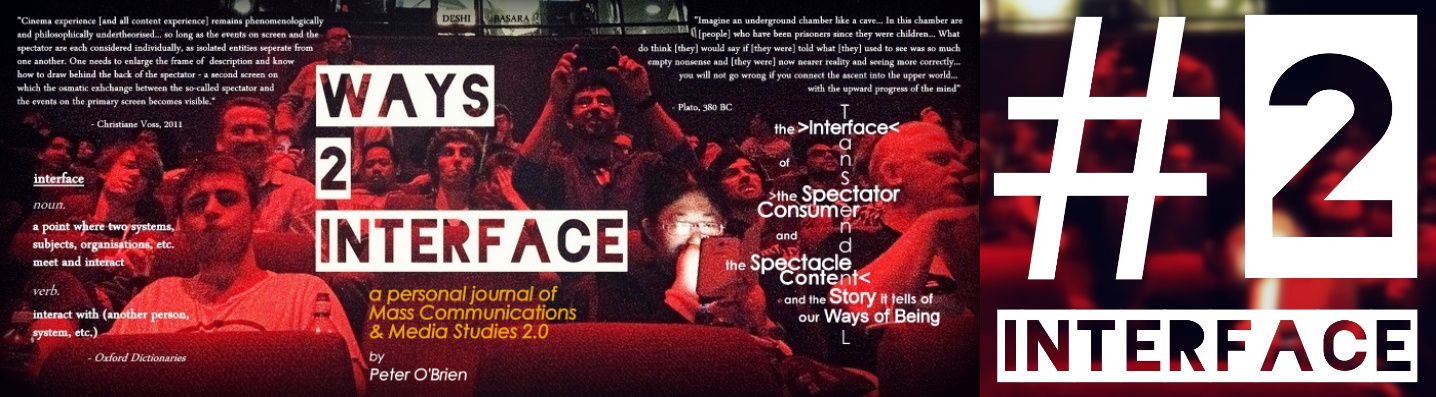
As a result, I have shifted my focus away from Ways 2 Interface while I have been building PeterOBrien.me and organising everything that I have going on. One key implication that has now become clear as a result of this organisation is that PeterOBrien.me will unload the burden of my Postgraduate 2.0 Studies on this Ways 2 Interface blog.
As I continued to study new MOOCs (now over eighty) and add them to my portfolio, the study page on this site was getting ridiculously out of hand. It was a problem I had previously encountered on my LinkedIn profile where I would add each new MOOC to my education section and watch my profile struggle to load as a result.
Unfortunately, this is the reality of Big Data that human beings are now having to face.
"Big data is a broad term for data sets so large or complex that traditional data processing applications are inadequate. Challenges include analysis, capture, data curation, search, sharing, storage, transfer, visualization, and information privacy."
- Wikipedia
What to do with it all and where to put it?
However, the configuration of PeterOBrien.me has now solved this problem, as I believe the layout of the Postgraduate 2.0 Studies page is much better suited to present a vast array of information in a concise form.
It has two slideshows...
 |
| A slideshow for the courses I have enrolled myself in. |
 |
And a slideshow for the courses for which I was awarded a certificate.
|
Simple.
Additionally there is a link to an Excel spreadsheet that lists all of my MOOCs in chronological order together with other relevant enrolment details, if a user wishes to examine such details.
There is also a traditional list at the bottom of the page numbering all of the MOOC I have enrolled in with hyperlinks to their respective course pages.
Therefore the Studies page on Ways 2 Interface will soon be disappearing.
 |
| Make the most of it while it is still here. |
Additionally, while I will still continue to blog about my studies on this site, the content of those posts will be focused more towards being in relation to my larger transdisciplinary research project, for which the Ways 2 Interface website was originally established.
For more general MOOC reviews, reflections, recommendations, insights, etc., the blog of PeterOBrien.me will take of these.
As PeterOBrien.me will demonstrate, the only way in which I can organise my life and my focuses, while retaining my sanity, is by compartmentalising everything; this is why I have various different online platforms (or filling cabinets) for different purposes...
- Ways 2 Interface - transdisciplinary research
- Something to do with Film - film-centric
- Breaking Cinema - to host my podcast (not up yet)
- Forward Facing Visualographer - my visual creations
- DigitalMarketing.me - one-off blog created as part of my Digital Marketing studies
- 366 FRAMES 2012 - one-off self-contained project
- 365 FRAMES 2015 - one-off self-contained project
- EYES of a Storyteller - one-off self-contained project
... and PeterOBrien.me is the main hub (or office) that brings them all together into a unified overview.
Crucially, as the name of my personal website should indicate, they are all me, everything that I have created online is me, so I am going to insure that I keep a firm grasp on it all.
Another key aspect of myself, or the digital extension of myself IS all of the MOOCs I have enrolled myself in, these are parts of myself as well, and, in particular, clusters of related MOOCs naturally come together to represent specific focuses of my career focus and wider interests.
It is for this reason that if you examine PeterOBrien.me you will note that in addition to my Postgraduate 2.0 Studies page, there are additional pages devoted to specific MOOC and study focuses.
I have individual pages for...
- Entrepreneurship
- Digital Marketing
- Emerging Technologies
- Career Success
- Web Science
- Solid Science
- Big Data
- Neuroscience
- Psychology
- Filmmaking
- and I am probably going to add another one based around Digital Making, that may just be combined with the Filmmaking one, because the fact that I am a filmmaker kind of speaks for itself. I have not decided yet.
It is should be noted that one of my focuses is Digital Marketing and this is not accidental.
Digital Marketing is something I wanted to get to grips with ever since graduating from my BA (Hons) and it is not accidental that I have spent the last two years exploring and defining myself in order to construct an appropriate unified brand to encapsulate it all.
A value driven brand is essential for success in entrepreneurship and entrepreneurship is the primary objective of my postgraduate 2.0 studies, everything is working for everything else, that is the point.
"Entrepreneurs are competing for resources and opportunities that enable them to tell their story and build their reputation. If you’re an entrepreneur who isn’t actively branding himself, rest assured that your competitors will waste no time in branding you, which may hurt your image, company valuation and bottom line."
- Michael Georgiou, Entrepreneur
PeterOBrien.me is a fusion of personal and professional and my key driving impulse in making it was to produce 'an online portfolio to end all online portfolios'.
A similar phrase, 'the film dissertation to end all film dissertations', worked in producing my award-winning undergraduate theoretical dissertation, Ways of Being: The Spectator and the Spectacle (the progenitor for Ways 2 Interface), so I do not see why it will not work for producing a personal website that utilises the entirety of my professional portfolio and personal life experiences as a combined visual-centric portfolio of my values, my character, my strengths, my skills, myself.
 |
If you do not know what you are, then how will you know what to do with yourself?
|
With the design of PeterOBrien.me, the idea is that you click on what appeals to you and within that page there will be details and links to other relevant and related components of my overall portfolio.
Or you can just have the brief visual-centric storyboard overview of my overall portfolio on PeterOBrien.me's main page.
Every good day, every bad day; complex and simple at the same time - that's very me, that's PeterOBrien.me.
However, going back to my Postgraduate 2.0 Studies and as they are now organised and collected on PeterOBrien.me, I am no longer going to be providing periodic progress updates or MOOC by MOOC reflections on Ways 2 Interface.
There are two reasons for this...
- I do not need to provide periodic progress updates because the MOOCs as arranged and detailed on PeterOBrien.me speak for themselves. If I do provide a periodic update I will do it on the blog of PeterOBrien.me and I will only do it on Ways 2 Interface if that progress update is immediately applicable to the research concerns of this platform.
- It is becoming impossible to provide periodic updates and reflections on each MOOC because I study so many! I rarely find the time to provide updates or to author reflections; unless, of course, those reflections are required exercises of the MOOC I am studying, such as is currently the case with the DigitalMarketing.me blog I had to create for my Digital and Social Media Marketing MOOC. I do not underestimate the power of reflection and of getting your head in order by objectifying it, but I also always respect the concept of time and realise that I only have so much of it! However, I have now started to produce video reflections and reviews of my MOOCs as evidenced within my 365 FRAMES 2015 project, which is a quick, easy and spontaneous way of generating reflection material. As a result of this, I will continue to produce these videos instead of lengthy, time-consuming written reflections, such as I am doing now!
However, I will provide one final and very brief MOOC progress report right now.
I am currently enrolled in...
Priority:
- Digital and Social Media Marketing - as part of the iversity Marketing Toolkit
- Logical and Critical Thinking
- Understanding Video Games
Secondary
- The Importance of Money in Business
- What is a Mind?
Tertiary
- Mindfulness for Wellbeing and Peak Performance
- Introduction to Big Data - as part of the Coursera Big Data Specialization
- Quantitative Methods - as part of the Coursera Solid Science Specialization
- Marketing in a Digital World - as part of the Coursera Digital Marketing Specialization
- Fundamentals of Neuroscience, Part 1: Electrical Properties of the Neuron
- The Mind is Flat: The Shocking Shallowness of Human Psychology
Finally, I will very shortly be reconfiguring the Ways 2 Interface website to be bring it into line with the changes I have cited in this blog post and some additional ones I have not detailed.
In particular specific changes concerned with the transdisciplinary research of Ways 2 Interface and how that will play into the content of Breaking Cinema, the podcast I have been developing.
But more on this later...


