Showing posts with label Understanding Language. Show all posts

Sunday, 21 December 2014

English has gone global - Understanding Language - week 4 reflection/course conclusion #FLlanguage #MOOC


Global English is a major component of the MA in English Language Teaching that the University of Southampton offers in partnership with the British Council; the same MA that this MOOC has served as a brief introduction/teaser for and was very much being crammed down my throat in this final week!

The focus of week 4 of the Understanding Language MOOC was on english as a lingua franca - a language that is utilised for communication between two or more individuals who do not share a native language - and a consideration of the emergence of the controversial new Global English. 

As with weeks 2&3, I did not gain much from this fourth and final week of the MOOC. Ultimately, while it has provided some new insights, I have largely found the Understanding Language MOOC to be a huge disappointment. 

Week 4 notes, there were not many.

The week  dealt with the historical spread of the english language across the globe while considering whether this was necessarily a good thing and then used this foundation to consider the global presence of the english language today. 

In particular, it's role as a lingua franca a.k.a. a go-between language in international fields, such as academic, the UN, etc., was discussed; as was the emergence of english language variants which exist and vary precisely because english has been absorbed by so many different cultures and has been adapted accordingly. 

This area of teaching and research that is focused on english language variants has become known as Global English and it is quite controversial. Ultimately, Global English is a major component of the MA in English Language Teaching that the University of Southampton offers in partnership with the British Council; the same MA that this MOOC has served as a brief introduction/teaser for and was very much being crammed down my throat in this final week! 


Kill the tuition fee and no problem.


One of the incentives for universities to create MOOCs is so that they can advertise their institution's expertise and course catalogue in the hope that you might be persuaded to sign up for something - I have no problem with MOOCs doing this. However, if the MOOC offers you next to nothing while it is trying to win you over - as I have found to be the case with the Understanding Language MOOC - I am going to be very annoyed!

Yeah, I was not very enthralled by this final week or the way in which it did not really tie together the weeks that came before it! 

Overall, the Understanding Language MOOC has just felt too much like the University of Southampton was trying to sell me the MA in English Language Teaching, opposed to actually teaching me something new. 

I was very surprised because the University of Southampton also produced the Web Science MOOC I am quite big on and, while that was also advertising a new degree they have started at their institution, the MOOC itself offers you an awful lot on its own!

However, not long after the Understanding Language MOOC concluded, FutureLearn announced a new batch of courses and the one created by the University of Bristol caught my eye: Cultural Studies and Modern Language: An Introduction

I have already signed up, it sounds very promising...

"By the end of the course, you will have heard twelve examples about how language and artifacts contribute to culturation and development; collectively these examples will introduce you to a methodology on how to understand other cultures."

While the Understanding Language MOOC has been a bit of a let down, it has at least started to introduce me to the conceptual foundations of language learning, so with any luck the Cultural Studies and Modern Languages MOOC will build on those conceptual foundations and fully set me on my way to start learning another language somewhere down the line.

You can read my other posts on the Understanding Language MOOC below:


Friday, 19 December 2014

Classrooms and Technology - Understanding Language - weeks 2&3 reflection #FLlanguage #MOOC


I believe that the current expansion into online learning is starting to change this and all these online MOOCs offer additional study resources for students and educators to exploit. I believe there now needs to be a greater cohesion between face-to-face learning and online learning programs, as both offer merits that supports the other. Knowledge is great, but the human being evolved as a result of being a social animal.


I have bundled weeks 2 and 3 of the Understanding Language MOOC together because they are really two sides of the same coin. 

Week 2: Language Teaching in the Classroom deals with traditional classroom based methods of teaching language

and

Week 3: Technology in Language Learning and Teaching deals with progressive forms of language acquisition and it's tutelage in today's digital focused world.

This reflection will be a short one mainly because I drew far less from weeks 2 and 3. The content of weeks 2 and 3 was not a poor quality, but rather it was mostly material that I had covered previous and from my point of view is pretty common sense.


 Week 2: Language Teaching in the Classroom 


The main emphasis of week 2 is on the classroom, the 'community' therein and how the construction of this collaborative community and the relationship between educators and students is intricately important in the acquisition of new languages.

A key point that is made is the difference between naturalist and classroom teaching which is to say that there exists a huge difference between learning a language in a classroom setting opposed to acquiring it by immersing yourself in the everyday culture for which the language you are learning is utilised. 

A classroom is a community of practice.


In addition to using the classroom setting to break down a language to it's conceptual foundations, the real challenge for language educators is to structure their programs of study in such a way as to also stimulate naturalists/spontaneous language exchange within in the classroom and its culture of students: 

"in the 1970s and '80s, we went through a phase of thinking that classrooms should really imitate naturalistic language learning, and classrooms should be imitating first language learning. I think research in recent decades has told us that that's too simple a story, that classroom learning is a more complex business than that. Yes indeed, classrooms need to provide input, and need to provide a focus on meaning, and on learners making their own meanings, but classrooms also need to provide other things. First of all, it's been shown clearly that classrooms can help learners by actually developing their conceptual understanding of language, giving them key ideas that will help them make sense of the structure of the new language."  
- Professor Rosamund Mitchell, Understanding Language educator

Unfortunately, I am not really interested in teaching language learning, only in learning a language and most of week 2's content was aimed at language educators. 

The above point about the different between naturalist and classroom was not the only main point of the second week, but it is the only thing I have really taken from it - knowledge and experiential acquisition is not all done within the classroom, BUT the classroom can still help a great deal.

As ever, it's case of the best learning is done as a 50/50 split between practical and theoretical practice - something I learned while undertaking my undergraduate degree and presented as a welcome reminder here!

Certainly, I will be bearing this in mind when I do learn a language, whatever that language ends up being...


 Week 3: Technology in Language Learning and Teaching 

Week 3 of the Understanding Language MOOC was centered around the conceptual explorations of language learning in the digital classroom. A great deal of consideration was directed towards the differences between face to face learning and online learning and what makes an effective online educator. 


The basic success requirements of online learning.


As this blog will testify, I am big on digital and online learning, as I have already gained a great deal from it and I can see that it has ongoing potential that has yet to be fully tapped into, as I said in the comments section of week 3:

"This is my 36th online course and I have used various different online learning platforms. Overall, I have found it be a vastly more rewarding experience compared to face-to-face learning. The flexibility and choice online learning offers you means that you can tailor your learning to meet the requirements of your own personal development criteria. 

When I was at university, while I did adhere to the taught program of study, I found myself branching off to seek out other areas of learning that my degree program was not fulfilling, such as basic life and career skills that would enable me to actually utilise my degree when I graduated! This is a common complaint among students and academia seems to think it is okay to exist in a bubble that is far removed from reality. 

I believe that the current expansion into online learning is starting to change this and all these online MOOCs offer additional study resources for students and educators to exploit. I believe there now needs to be a greater cohesion between face-to-face learning and online learning programs, as both offer merits that supports the other. 

Knowledge is great, but the human being evolved as a result of being a social animal." 

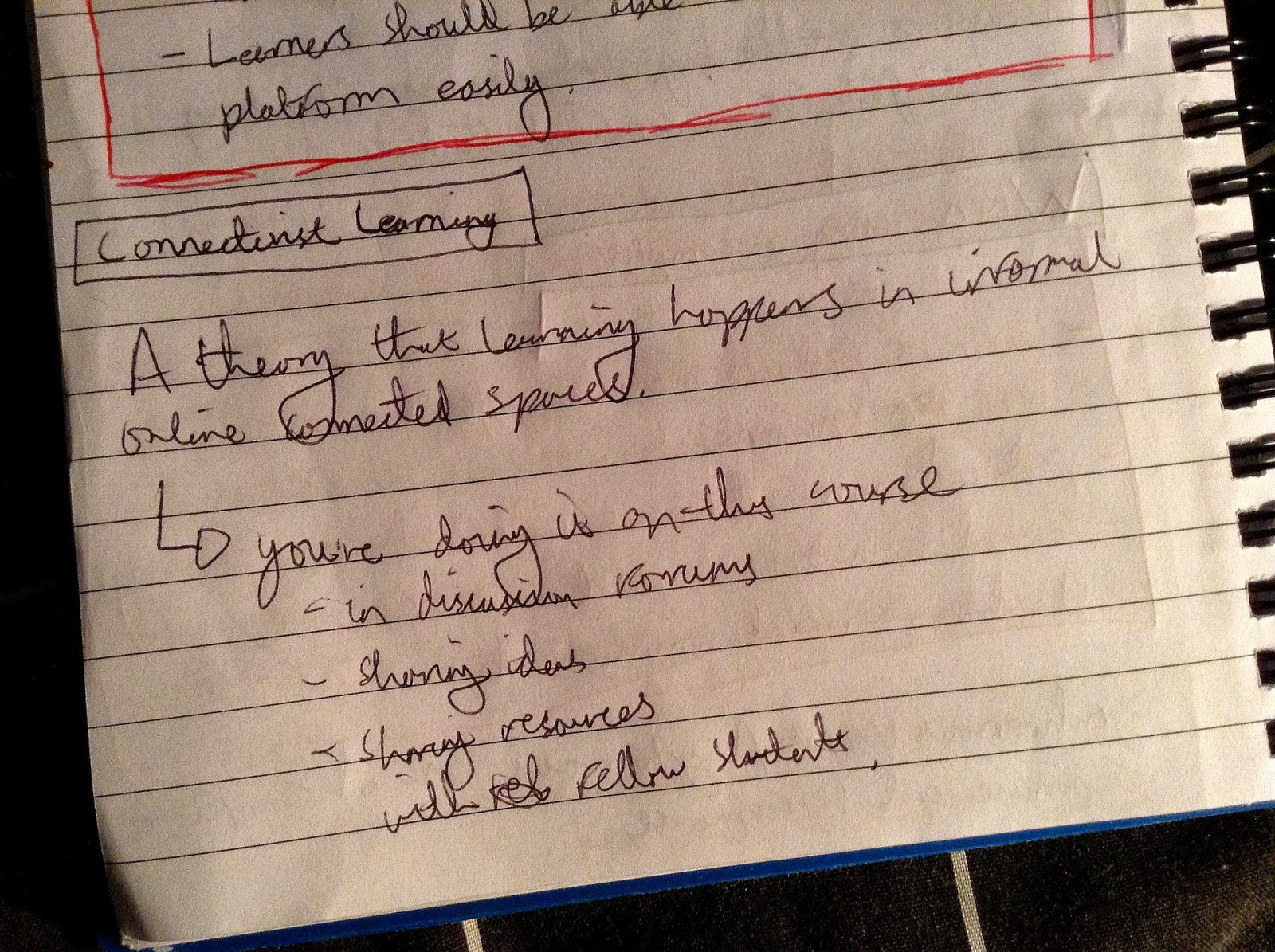
This social aspect was touched on briefly at the end of week 3 in the MOOC's consideration of connectivist learning.

Connectivist learning - I'm doing it with this blog!


Connectivist learning  basically refers to the sharing of informative resources and discussions via discussion forums, social networks, etc., and certainly with something like language acquisition, conducting in this connectivist on an international cyberspace, the usefulness of connectivist interactions in language learning should be plain.

However, as with the second week, the third week was mainly geared towards the students who aim to go and teach language, either in the classroom or online. OR, as I pointed out, to teach language vastly more effectively by utilising a combination of classroom and online teaching.  

Ultimately, what these two weeks taught me is that if I do eventually learn a new language, then the process of learning I should employ is the process of learning I am already utilising. 

Saturday, 22 November 2014

Do you take my meaning? Understanding Language - Week 1 Reflection #FLlanguage #MOOC


The emphasis of the first week of the Understanding Language MOOC has been focused on the theory behind language learning, as explored through a consideration of what comprises 'meaning'. 

'Meaning' was broken down into four subsets:

  • Lexical meaning - the meaning of words
  • Sentence meaning - the meaning of sentences
  • Grammatical meaning - the construction and manipulation of essential meaning within sentences
  • Pragmatic meaning - meaning of specificity in language transmission that relies on knowledge of the world and the discourse context

The consideration of 'meaning' is the main item I have taken from this first week, as the meaning of the english language is something that I have been increasingly considering more much minutely than my fellow peers; mainly because much of my schooling life I was largely illiterate and it was only when I approached university (about five years ago) that I decided it was time to get to grips with basic english grammar.

Notes from Understanding Language week 1.

I did this by getting my hands on various grammar books and working my way through them while testing myself. Certainly, this ongoing period of study greatly nourished my understanding of the construction of the english language, but I am still no expert on english grammar - I know enough to get by and seek out assistance when necessary.

One of the complaints of the grammar sticklers out there is that the UK's teaching on grammar in the education system is atrocious and, being mostly illiterate for much of my schooling life, I can agree with this statement. 


"To understand the rules, it is necessary to learn some of the words used in discussing grammar. Much of grammar is not taught in schools in Britain today, or is taught badly and unenthusiastically. Even those who were taught grammar at school have often forgotten most of it" 
- Bernard C. Lamp, The Queen's English, 2012:13.

This lack of understanding in regards to the english language is probably also the reason for why the UK has such an abysmal second language learning rate.

Notes from Understanding Language week 1.


Therefore, the point I am trying to make is that the only way I can apply the understanding of meaning in regards to a language is to apply that understanding to a language I already know, which is english, but If I do not fully understand the lexical, sentence, grammatical and pragmatic meaning of the english language, how can I ever hope to get my teeth into learning another language?

Notes on the Bottleneck Hypothesis from Understanding Language week 1.


Fortunately, I do mostly understand english, but if I am really serious about learning another language, then in addition to laying the theoretical groundwork of language learning in advance, I also need to be in a position where I am fully confident with my native language in both writing and the spoken word. 

Do you take my meaning?

I know how to speak english and I know english grammar - I know how to create, convey and manipulate meaning in the english language.

But I do not necessarily understand all of the mechanics behind how I am able to convey lexical, sentence, grammatical and pragmatic meaning in the english language.


"Learning the common rules of English can be very rewarding. It helps to have explained the reasons for what you may have been doing already; it can resolve doubts and uncertainties, and lead to correction of errors." 
- Bernard C. Lamb, The Queen's English, 2010:12.

Basically, I know the grammar, but I still do not know what is a 'verb' or a 'noun' or 'syntax'.

Seriously, I told you the education was pretty bad in this country!

Notes from Understanding Language week 1.


In my mind, there is an essential toolkit you need to possess when constructing your understanding of another language; it's a toolkit that you would have put together when learning your native language, but my toolkit is still incomplete.

Therefore, I have decided it is high time to fill those gaps, which is why I have started to work my through a previous grammar book I did not previously have time to intimately work my way through: The Queen's English by Bernard C. Lamb.


Regardless of what language you are utilising, its meaning is useless if your underlying knowledge does not understand how to take it or how to use it.


Up next...