Showing posts with label cyberspace. Show all posts

Sunday, 21 July 2024

The Network-Narrative: The World Wide Interface

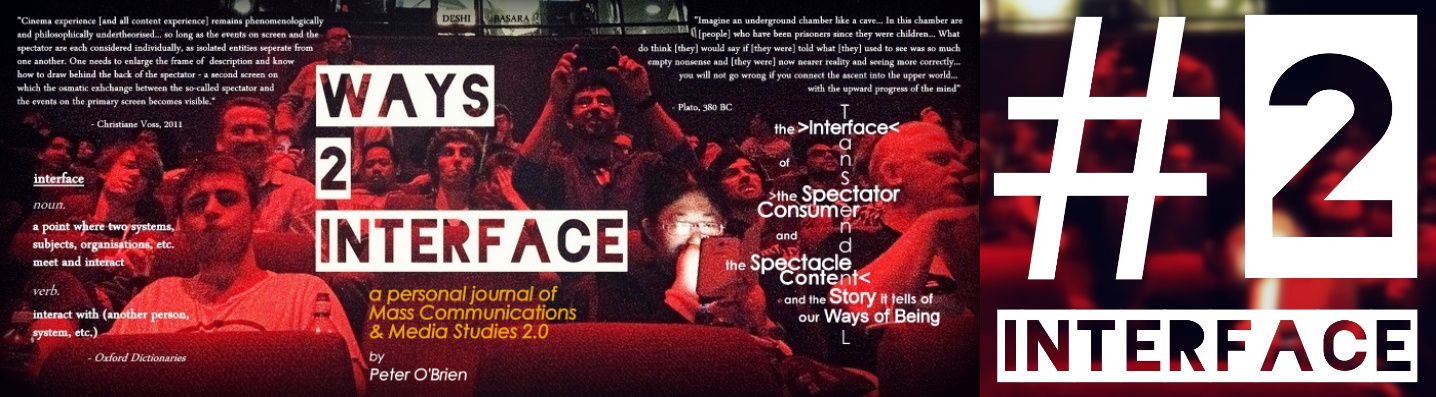
The following is an unpublished post from 2014 that would have formed one part of the introduction for the Ways 2 Interface research project.


The Bigger Picture


There is a bigger picture today, a vastly bigger picture. When we discuss the spectator and the spectacle we are invariably discussing this bigger picture; even when we think we are just discussing a piece of entertainment content or our own relationship with it, we are delving into a discussion of a bigger picture. 

The age of the upgrade is dominated by cyberspace and technological convenience. The modes for telling stories continue to proliferate and our participation in those modes and in the creation of our own recorded stories is a fact empowered by the digital rebirth. 

In terms of gaining an understand our day-to-day existences and to continue living our day-to-day lives practically, this is a fact we ignore at own peril.


One could argue that the world wide web/cyberspace is the greatest cultural artifact the human race has produced thus far. Why? Because it is being shaped and imprinted upon by every single person who uses it! 

The inhabitants of this planet are creating a depository of information - a networked-narrative - of its ways of being, from the beginning of its existence, even its theories on the beginnings of reality itself, to reflections of its current affairs and speculations of where it is going... and what I just wrote is now a part of that network-narrative.


“If memory is our means of preserving that which we consider most valuable, it is also painfully linked to our transience. When we die, our memories die with us. In a sense, the elaborate system of externalized memory [of cultural artefacts] we’ve created is a way of fending off mortality”
- Joshua Foer, Moonwalking with Einstein, 2011:19


The Fictional Truth


Whether by chance or by our own design, longevity and immortality is something we can only achieve external to our corporeal selves via the spectacles that we leave behind.   


An imprint of a person long since gone - a nuclear heat shadow in Hiroshima.


“The soul's made of stories, not atoms” 
- The Doctor, Doctor Who: The Rings of Akhaten, 2013


If you have access to the internet, the chances are, you have established an online identify. The primary way of doing this is via the social media platforms and the most primary of these is currently Facebook. 

My Facebook timeline: a part of the digital me. 
  
By creating a Facebook profile you are leaving an imprint of yourself online; every time you post something on Facebook you are adding to that imprint and causing your online shadow to grow. A platform like Facebook is a daily log, it is a diary, everyday you add new snapshots to it (see 366 FRAMES 2012: My 366 Project). Your online presence is the recorded narrative and it will be the narrative of your life once you have gone. 

On its own, cyberspace is a cold realm of code, but our participation in its shaping gives it meaning, we are the footprints in the snow. 

And the same is true of the entirety of your online presence. Every single thing you attribute to yourself online will go on to become a part of who you were; all those media empowered elements will become a part of your narrative, your spectacle, your imprint.


“Adults and children sometimes have boards in their bedrooms or living-rooms on which they pin pieces of paper: letters, snapshots, reproductions of paintings, newspaper cuttings, original drawings, postcards… they have been chosen in a highly personal way to match and express the experiences of the room’s inhabitant. Logically, these boards should replace museums.”
- John Berger, Ways of Seeing, 1972:23


Forty years on, in addition to our bedroom walls, we now also have Facebook walls. Whether it be a poster, a status update, or a YouTube video, It is crucial to understand our want to pin and post pre-established media contruct material on these walls, because understanding it will explain our want to engage, absorb and promote the media in all its varied forms. 

Fundamentally, it all boils down to narratives and why we take reality and remold it into narrative forms. We have told and engaged in stories from the year dot. From the first time we left an imprint on our cave wall and probably quite a while before...

41,000 years later, the imprints of a person still remains.


"Cave paintings demonstrate that cavemen understood visual representations as being about more than the process of looking. Perhaps even more so, cavemen understood that visual presentations were also absorptions into something bigger."
- Ways of Being: The Spectator and the Spectacle, 2013:99.


The Bigger Narrative
The sustainability of our day-to-day psychologies depend on being a part of a bigger narrative. Everyday we experience stories, we engage in stories, we exchange stories and we tell ourselves stories inside our heads. 

"Narratives are intimately linked to the human intellect, because they offer us explanations of a world that does not make sense." 

- Ways of Being: The Spectator and the Spectacle, 2013:99 


Stories enable us to grow, they console and make us whole - it is through them that we are able to come to terms with death and are able to achieve transcendence

Through a process of interfacing, the two databases of the spectator and the spectacle speak a fundamentally ancient language - the language of narratives. 

And, ultimately, through the process of exchanging that dialogue, they are able to grow bigger. Narratives, as told in any medium, enable our intellects to grow from one form into another, story-after-story, experience-after-experience:


"What is it about stories, anyway? Anthropologists tell us that storytelling is central to human existence. That it’s common to every known culture. That it involves a symbiotic exchange between teller and listener — an exchange we learn to negotiate in infancy. Just as the brain detects patterns in the visual forms of nature — a face, a figure, a flower — and in sound, so too it detects patterns in information. Stories are recognizable patterns, and in those patterns we find meaning. We use stories to make sense of our world and to share that understanding with others. They are the signal within the noise. So powerful is our impulse to detect story patterns that we see them even when they’re not there."

As I have already commented to several people who have confused my aims for this project as being concerned with films alone (which is understandable considering my love of the medium), I have said this: 

In this project (and in Ways of Being), I am not just talking about films, or even about media as whole, what I am discussing is our ways of being and how, through our interfacing ways of being spectators and spectacles, narratives are central to and expressions of our universal ways of being

This is a much more fundamental endeavour: I am talking about how films, media, storytelling, cyberspace, our perception of reality, etc. and how we interface with all of these inventions play into our ways of being and how they can explain our ways of being.  

Ways 2 Interface is about how we interface with the bigger picture, the bigger narrative - the network-narrative, technological and neurological.  


Read part 7 (the final part) of the introduction - Something #todowithfilm: Me, My Path and My Research Web 

Saturday, 29 November 2014

Information is an asset - Introduction to Cyber Security - completion reflection #FLsecurity #MOOC


Successful and vigilant cyber security requires a proactive attitude in order to maintain your current situation and to be on the look out for new updates. Ultimately, it's not just about changing some passwords and then sweeping all concerns under the carpet. Introduction to Cyber Security is not a quick fix, it's a quick introduction, beyond it's teaching, you have to keep running with what you learned.


I have now completed Introduction to Cyber Security (a week ahead of the official completion date) and the main realisation I have taken from the course is that all information is an asset, especially your personal information!


All done and dusted.


Our day-to-day activities online and on our personal computing devices offer countless means for our personal data to be compromised and exploited by cybercriminals. 

Introduction to Cyber Security offers a great deal of clarity on this subject by providing overviews:

  • of the threats that currently exist and how they actually function
  • of how you can minimise the possibility of being a victim to one of these threats.
  • of what to do if you are compromised by a threat.
  • of real life compromisation examples: how they happened, how they were dealt with, the long-term consequences.
  • of how computing, online networks and digital security systems actually function 
  • of how computing, online networks and digital security systems are often compromised.
  • of how cyber security is not an exact science and never will be - it's about educating yourself to always be on your toes!


Cory Doctorow presents Introduction to Cyber Security

The main idea to understand in regards to implementing strong cyber security is in understanding three basic aspects underpinning effective security:


  • Confidentiality - our data to only be accessed by appropriate individuals.
  • Integrity - our data to only be manipulated by authorised parties.
  • Availability - our data to be accessible whenever we want.

Once you have these principles understood you are in a vastly better position to assess your own cyber security in regards to your daily activities and the other individuals and/or organisations with which you come into contact.

If authenticity can not be verified or if confidentiality can not be guaranteed, then there is cause for concern.


CIA - Confidentiality Integrity and Availability.


While undertaking the course, you are very much encouraged to put into practice what the educators advise as minimalising your exposure to a potential threat. This practice is very accessible as there are many step-by-step guides included as part of the course materials.

The undertaking of this course has been pretty well timed, as improving my cyber security situation is something that I have been very actively improving for some time now; in particular since August when I was having trouble with my desktop computer and then when I was setting up my new laptop (which I acquired to replace my desktop computer). 

A couple of months back my bank account was very nearly compromised, but fortunately my banking security got on the case and my credentials were reset and no money was lost. I still do not know how my bank account was compromised, but this incident has made me much more vigilant in regards to my cyber security practice. 


Therefore, the Introduction to Cyber Security course has served as a natural progression on from what I have already done by filling in the gaps of what I had not done or of which I was a little unsure.

The course is broken down into the following areas: 


  • Week 1: Threat Landscape
  • Week 2: Authentication
  • Week 3: Malware
  • Week 4: Networking and Communications
  • Week 5: Cryptography
  • Week 6: Networking Security
  • Week 7: When Your Defences Fail
  • Week 8: Managing Security Risks

The time span and content of the course has quite nicely and reflexively criss-crossed with the Internet History, Technology and Security MOOC I have just about completed. In many ways the Internet History, etc MOOC has lain the historical and technical groundwork for what I have been learning in Introduction to Cyber Security.

The two MOOCs very strongly compliment each other and I would say that the Cyber Security MOOC is the natural successor to take after completing the Internet History, etc. MOOC.

Only the last two weeks of the Internet History, etc. MOOC have been devoted to security, so I have been given a huge and very detailed preview of those last two weeks with the Cyber Security MOOC. 

This is just as well, as I suspect I would not have been able to have been able to get my head around the concept and workings of public and private keys in the Internet History, etc. MOOC had I not already encountered it in the Cyber Security MOOC. 


The internet - a network of networks.


Likewise I would have struggled with the presentation and explanation of internet networking, communications, IP protocols, etc., in the Cyber Security MOOC had I not already had it very minutely illustrated in the Internet History, etc. MOOC.

However, one of the most startling discoveries I have had revealed from both of these MOOCs and which has provided even more incentive to become highly literate in cyber security is the fact that the internet is not encrypted - it's an open space for all to see what passess through it (if you know how). 

The reason for why the entirety of the internet is not encrypted is because it would require way too much computing power to encrypt and decrypt every single piece of information that goes through it. Therefore, only sensitive material, such as online payments, are encrypted. 


https - the 's' tells you that the current webpage you are on is secure and is a verified web page. If you click on the padlock a drop down will reveal more information about the web page you are on. The main point to be taken from this is: if there is no https and the web page is asking you to hand over some personal data - don't, because that web page is not secure!


Additionally, a user can choose to encrypt their data where appropriate (emails being a primary target), but only when the user understands how to go about utilising encryption and decryption and this is something that the course touches upon an encourages.

I have implemented many of the course's suggested practices, such as:


  • taking stock and organising of my information assets (this is ongoing, it's a lot of stuff to get through)
  • rejigging all of my passwords and setting up a password manager (this took the better part of a day)
  • ensuring that my security software and firewalls are up to date
  • utilising signed and encrypted email (I am working on this)
  • being aware of how exposed I can leave my devices and data in public spaces and securing them appropriately
  • nurturing better awareness of tell-tale signs of threats and indications of strong cyber security, e.g. phishing emails, checking for https.

It can get confusing, but understanding it will make you literate and cyber secure.
I believe there are two issues are at the root of the reason for why so many people of ignorant towards their own cyber security and how that can be hugely detrimental to them:

  1. Lack of overall understanding to all the threats out their, how to counter them and the consequences of not countering them.
  2. getting into and staying in the habit of consistently maintaining high standards of cyber security practice.


As I have come to learn from the course, understanding all of the potential threats, how you can counter them and what are the long term consequences of not countering them is easy, once you invest the time and effort into actually understanding the emerging subject of cyber security.

However, consistently maintaining high standards of cyber security practice requires vastly more effort and that is the challenge I am starting to understand now - starting is easy, staying in the habit requires much more effort and perseverance. 

Not all aspects of cyber security are convenient or painless and, as the internet and the technologies and the algorithms that support the internet continue to grow and change and improve, so too will the cyber threats. 


Cyberspace cryptography.


Successful and vigilant cyber security requires a proactive attitude in order to maintain your current situation and to be on the look out for new updates. 

Ultimately, it's not just about changing some passwords and then sweeping all concerns under the carpet. Introduction to Cyber Security is not a quick fix, it's a quick introduction, beyond it's teaching, you have to keep running with what you learned.

For quite some time now I have placed a great value on my time, even greater than I place on money - time is finite, but you can always acquire new money! I also place a high value on my overall well-being which I also place this higher than money - if you're dead, you can't make any money. 

Like time, health and money, your information - your identity - is an asset. A very valuable asset! 

Therefore, realise, as I have, that if you want to keep your information/data/identity/cyber presence healthy, secure and in a position to keep you financially content, you are going to have to invest consistent amounts of your time into maintaining a vigilant defence about it.


Common tell-tale signs of a phishing email - delete these!


Ultimately, like the Open University's earlier Managing My Money MOOC (which I have yet to complete) that offered a grounds up look at basic and successful personal finance terminology and practice, Introduction to Cyber Security is designed for anyone and is intended for anyone - utilise this free resource and reaps the rewards further down the line.

Information, just like time or money or maintaining good health, is a vital asset of a productive and fulfilling life - do not allow it to be compromised. 

Your information is an asset, so look after it!

Be smart and be secure.