"I am going to watch a film," when this common statement is expressed, you are exerting a fundamental ignorance hardwired into the human intellect; yet, it is an ignorance that expresses a fundamental truth about our comprehension of the world and of our cultural artefacts therein.
This post will examine the two very badly defined entities known as the 'spectator' and the 'spectacle'. Through exploring their inherent short-sighted fallacies, their usefulness will be determined in regards to attaining a thorough holistic understanding of spectatorship as a whole, our ways to interface and what we actually mean when we say: "I am going to watch a film."
What is Spectatorship?
However, from an academic perspective, 'spectatorship' more commonly refers to the study of spectators and spectacles and their relation to each other. To this end, the essential purpose and aim of Ways 2 interface is the study of spectatorship.
Ultimately, gaining a thorough understanding of a spectator's relation to any kind of spectacle (film, theatre, painting, the guy who trips on his shoelace) requires a fundamental understanding of why the human intellect divides everything into spectators and spectacles. It is an essential constituent in us all and it has created the cultures we inhabit; to this end, when attempting to make sense of it, we need to consider a bigger picture.
Therefore, while still utilising its considerations and using them as a jumping on point, this project will look beyond the focus of film spectatorship and, through a holistic and transdisciplinary approach, Ways 2 Interface will study spectatorship in a much broader context, in relation to a wide variety of interfaces.
However, I loath to use the term 'spectatorship', because it defines everything that is problematic and shortsighted about the traditional treatment and considerations of the spectator and the spectacle; as do the terms 'spectator' and 'spectacle.'
What is a Spectator?
Spectator
noun.
A person who watches at a show, game, or other event: around fifteen thousand spectators came to watch the thrills and spills.
a.k.a.
onlooker, watcher, looker-on, fly on the wall, viewer, observer, witness, eyewitness, bystander, non-participant, sightseer; commentator, reporter, monitor, blogger, beholder, bystander, fan, moviegoer, observer, onlooker, sports fan, theatergoer, clapper, eyewitness, kibitzer, looker, looker-on, perceiver, playgoer, seer, standee, watcher, witness, gaper, gazer, showgoer, stander-by
 |
| You are a spectator of this spectator (and spectacle). |
What is a Spectacle?
Spectacle
noun.
A visually striking performance or display: the acrobatic feats make a good spectacle.
[mass noun]: the show is pure spectacle an event or scene regarded in terms of its visual impact: the spectacle of a city’s mass grief.
a.k.a.
display, show, performance, presentation, exhibition, pageant, parade, extravaganza, sight, vision, view, scene, prospect, vista, outlook, picture, exhibition, laughing stock, fool, curiosity, comedy, demonstration, display, drama, event, extravaganza, movie, pageant, parade, performance, phenomenon, scene, sight, spectacular, tableau, curiosity, exposition, marvel, play, production, representation, show, view, wonder
 |
| As is the photo... and this website... and your monitor... and the way YOU see your monitor in relation to whatever is around it... |
The Blindness of the Spectator and the Spectacle
"I am going to watch a film."
This statement is a falsehood, because we do not watch films and we never have. However, if you were to say I am going to watch and listen to a film, then you are getting closer to what is actually going on.
“We watch films with our eyes and ears, but we experience films with our minds and bodies. Films do things to us, but we also do things with them. A film pulls a surprise; we jump. It sets up scenes; we follow them. It plants hints; we remember them. It prompts us to feel emotions”
If you wanted to be accurate, opposed to saying: "I am going to watch a film," you would say: "I am going to experience a film."
We do experience films and other forms of audio-visual content with our minds and our bodies and, in addition to experiencing them with our eyes and ears, we are also able to taste, smell and touch the larger experiences they enable and the brands they embody.
What can you taste?
Whenever I experience Home Alone (1990) I always associate it with and get a huge craving for roast chicken, because many, many years ago I 'watched' the film while eating some absolutely scrumptious roast chicken.
Whenever you eat popcorn, you taste a bit of the quintessential cinematic experience brand. Furthermore, taste is made up of the sensory input of your tongue and your nose, so you smell it as well. You have to use your hands to grasp each new handful of popcorn, so you find yourself touching it also.
Have you ever considered what effect the large sugar loaded and iced cooled Coke Cola sat in your cup holder is having on your film experience?
Not to mention the air conditioning:
"Today, technology has substantially improved the clarity of sound and the visibility of the screen. However, the quality of a show doesn’t depend solely on crystalline highs and rumbling lows. It is an integral well-being that comes from a comfortable setting where the rights temperature, the correct degree of humidity, and calibrated filtering and recirculation of air make the spectator completely comfortable."
The point I am trying to make is that:
- no matter what form of content you are experiencing
- no matter what device you are experiencing it through
- no matter what location you are experiencing it in
- no matter who you are experiencing it with
- no matter what prejudices you bring to it
- everything that exists with you in that process of experiencing has some influence on the result of your overall experience.
Granted, some factors, such as the image and the sound, will have bigger influences, but everything is prevalent and should not be ignored when dissecting that experience.
The human body is just one huge sensory membrane. Your
body is always aware of its surroundings; you may not be
consciously privy to everything your body is taking in, but your mind is processing that information and, even if subconsciously, it is having an effect on you and whatever situation in which you happen to find yourself.
This realisation of a larger sensory input is something of which we are now becoming more and more aware and which is being commoditised accordingly.
“One
of the major fallacies of contemporary film theory has been to imply
that spectatorship in the cinema is inherently voyeuristic. This
emphasis on the cinema’s voyeuristic character results from an
overvaluation of the role that vision plays in determining the emotional
responses of the spectator”
We take for granted what the conceptual constructs of these words imply and we use them carelessly. By focusing on the visual-centricity, that is encouraged by these terms, we are blinding ourselves to the bigger reality.
"The blood vessels that feed the receptor cells sit on top of the retina –
between the light source and the receptive layer. The estimated
prevalence rate for retinopathy, e.g. severe loss of sight, for US
adults 40 years and older is about 50%. It is caused by proliferated blood vessels obstructing the light."
We rely on sight so strongly and yet the human eye is hugely flawed, as is spectatorship's reliance on the concept of seeing and visual interpretation.
Visualising a Shortcut: Our Belief in Seeing
However, while it will benefit us to realise the broader context of
understanding beyond the 'spectator' and 'spectacle' terms, the fact that
these visual-centric terms have become so prevalently used, both academically and non-academically, in the ways that we discuss both the academic and non-academic subject of spectatorship does actually tell us
something fundamental about our ways of being.
"One
third of your brain's cortex is engaged in vision; when you simply open
your eyes and look around, you're using billions of neurons and
trillions of synapses just to see the world"
This over-reliance on sight and seeing is hardwired into us; the fact that so much of our brains is utilised for it demonstrates that we have evolved with a high regard for the information that sight and internal visualisations can give us.
"The advent of spatial vision provided immense survival value for the creature that had it."
“The advent of spatial vision provided immense survival value to the creature that had it
— but the process occurred slowly, over countless steps, with the
transition from a simple eye spot to the vertebrate-style camera eye
possibly taking as long as 100 million years,” he concluded.
Read more at http://www.redorbit.com/news/science/1112908953/understanding-human-eye-origin-evolution-072913/#mFgFiEMR54sXYb4I.99
Therefore, it can be argued that whenever we use the terms 'spectator' or 'spectacle' or say that: "I am going to watch a film," we use them in an almost pragmatic manner.
Subconsciously, we know there is a greater complexity beneath what these terms are pointing towards, but we refer to the 'spectator' and 'spectacle' entities as visually-centric spectators and spectacles, because it is easier for our conscious intellects to understand them as such - it provides a summation that concisely prioritises the information we need in order to act productively in our everyday lives.
In the same way that if I were to find myself in a burning building, opposed to smelling, touching, tasting or hearing my way to safety, it is vastly easier for me to use my sight to navigate away from the flames.
In truth, sight is our shortcut to comprehending the world:
"it gives a dumbed down, pretty guide to behaviour. It's guiding your behaviours so you can get done, what you need to do."
In this post I have used images - a conscious being (me) who is observing a screen presenting a spectacle - to visualise the most basic definitions of the spectator and the spectacle.
"What we see has a profound effect
on what we do, how we feel, and who we are. Through
experience and experimentation, we continually
increase our understanding of the visual world
and how we are influenced by it. Psychologist
Albert Mehrabian demonstrated that 93% of communication
is nonverbal. Studies find that
the human brain deciphers image elements simultaneously,
while language is decoded in a linear, sequential
manner taking more time to process. Our minds react differently to visual stimuli."
We
process visual information 60,000 times faster than text and, while the
images are not a huge simplification of relatively easy to comprehend and
widely known definitions, the images of the spectator and the spectacle could have been used without
including the worded definitions, that take slightly longer for our brains to process.
The research and our own habit of doing so demonstrates that humans have a visually prioritising tendency - we believe that seeing is believing.
Do you believe what you see?
Therefore, In
the same way that we use visual information to simplify the data of our world, the same is true of the spectator and the spectacle terms and our conventional tendency to see them as being purely visual in nature - they are
conceptual visualisations/simplifications of something that is vastly
more complicated.
Audio-visual
content, and cinema in particular, is a celebration of this visually prioritising and influencing fact inherent to our species, but, in
the same way that the visuals of a film are not providing the full
sensory stimulation of that film, regardless how much visual stimulation we may get from seeing, our sight is not telling us the full
story of the world.
93%
of our communication is non-verbal, but that does not mean that the
full 93% is devoted to sight alone; the other senses - smell, taste and
touch - have to be factored in alongside the visual and audio aspects:
"7% of any message is conveyed through words, 38% through certain
vocal elements, and 55% through nonverbal elements (facial expressions,
gestures, posture, etc). Subtracting the 7% for actual vocal content
leaves one with the 93% statistic.
However, studying human behavior is a challenging task. The inherent
flaws of social scientific research methodology combined with the
incredible dynamic nature of human behavior make this specific
quantification close to impossible.
The fact of the matter is that the exact number is irrelevant.
Knowing that communication is specifically 75% nonverbal or 90%
nonverbal holds no practical applications. The important part is that
most communication is nonverbal. In fact, nonverbal behavior is the most
crucial aspect of communication.
Based on my own research, I would state that the amount of
communication that is nonverbal varies between 60 and 90% on a daily
basis. This number depends on both the situation and the individual."
The spectator and the spectacle are conceptual shortcuts that, like human sight, rarely ever tell the full truth of what we perceive.
The Usefulness of the Spectator and the Spectacle
Simplifications they may be, but the lie of the spectator and the spectacle can tell us all an awful lot about the human being's inherent prejudice of seeing.
While this over-reliance on sight might have benefited us from a survival and productive standpoint, it is not the full truth of our sensual relationship with the world or, indeed, how we further experience that world through the intricate cultural artefacts with which we have populated it.
Visualisation is objectification and that is exactly what we have done with the concepts of the spectator and the spectacle, we have tried to understand something about ourselves and our relation to the world - external to ourselves.
Yet, the cold voyeuristic natures of the spectator and the spectacle have typically always lacked something vital in their endeavour of attaining an approximation of us - they have been devoid of us.
This is why it so important for us to re-understand the spectator and the spectacle, because, as they stand, they are only one part of a much bigger concept, a concept that requires objectivity and subjectivity in equal measure.
At the moment, what we have with the conceptual simplifications of the 'spectator' and the 'spectacle' is an objectified perceived-being-without, but, in order to gain a thorough approximation of ourselves, and our relation to what we perceive as being without, we need to factor in ourselves as the subjective actual-being-within.
I
believe it is important to realise this bigger conception of our
reality, because, as the two million year develop of our higher
intelligence and our increasing ability to dissect the workings of
reality has already demonstrated, just as much as we have an inherent
reliance on our sight, we also have a fast growing inherent compulsion
to transcend beyond it - to gain a greater intellectual understanding of
our ways of being.
"a central truth about wilful blindness: we may think being blind makes us safer, when in fact it leaves us crippled, vulnerable and powerless. But when we confront facts and fears, we achieve real power and unleash our capacity for change."
- Margaret Heffernan, Wilful Blindness, 2012:5
This will not just benefit us from an academic point of view, but from creative and humanistic perspectives as
well. I believe attaining a more thorough understanding of this subject
will enable us to greatly increase the effectiveness of our creative
endeavours and the way in which we live our lives.
In conclusion then, the 'spectator' and the 'spectacle' terms are not something that I am
simply going to disregard or even stop using. When we study
our relation to our world and to our cultural artifacts, the spectator
and the spectacle are not irrelevant, but, on their own, their
conceptual simplifications are not enough. To this end, in this project, I will be using them in a different context to the one that is widely understood.
Furthermore, in the field of spectatorship studies as a whole, when we discuss the spectator and the spectacle, we need to set an example by discussing them in relation to a bigger reality. A reality that incorporates vision, but ultimately transcends it.
This area of study should not even be termed 'spectatorship' and until a more accurate term comes along, I will rely upon 'Spectatorship Redux'. The study of the actual-being-within-and-the-perceived-being-without and how the concept of an interface is at the root of this process, this is the central focus of Ways 2 Interface.
Welcome #2interface
@ways2interface
#2interface
------------------------------------------------------------------------------------------------------------------------
In the follow-up to this post, Consuming while being content: 'consumer' + 'content' = IDEAL?, I will build on what I have discussed here in relation to the digital age's contemporary updates of the spectator and the spectacle - 'consumer' and 'content' and ask what these two commonplace terms can tell us about our relationship and understanding of our world and of the cultural artifacts we have created therein...
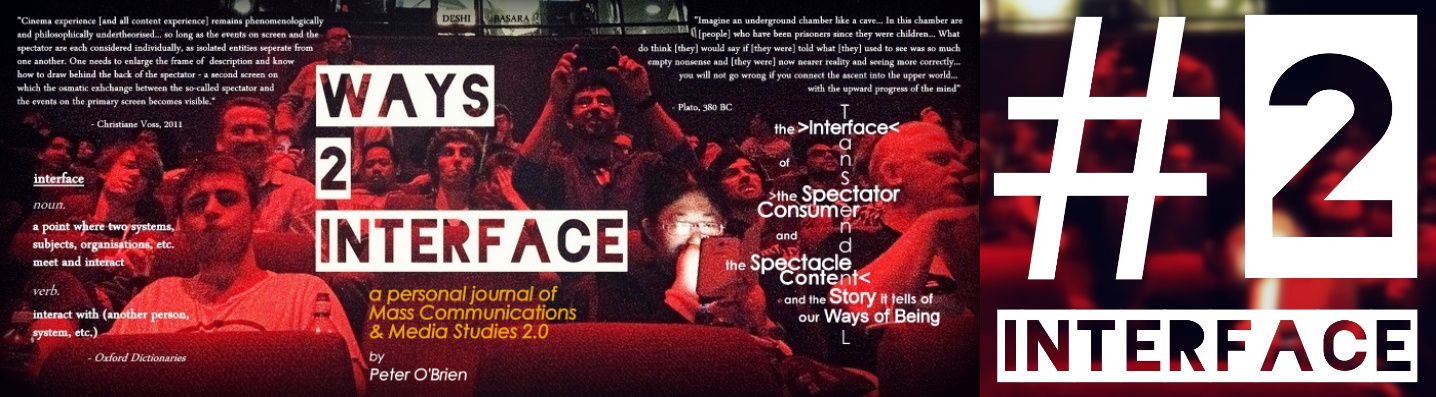

 The masters length paper was praised for its boldness, progressive thinking and received the highest mark that has ever been awarded to a Film and Screen Studies dissertation at Bath Spa University; as well as being awarded the Media Futures Research Award for Excellence in Film and Screen Studies research.


