Showing posts with label MOOC. Show all posts

Tuesday, 30 June 2015

Innovation for Entrepreneurs - Passed with DISTINCTION


I have now completed Innovation for Entrepreneurs: From Idea to Marketplace, the second course in my Entrepreneurship Specialisation, and I have passed with distinction!

My Innovation for Entrepreneurs signature track certificate and course participation details can viewed by clicking on this link.


Next up in my specialisation is to complete the exams for Funding for Entrepreneurs and numbers were never really my strong point...

Friday, 17 April 2015

Proactive Adaptability: Online Learning and MOOCs - Where to start?


Embrace the maze and mess and multifaceted realm of online study that WILL continue to change and that WILL continue to be recognised by employers, educators and new students.

I have been studying online since October, 2013 and after taking part in close to fifty MOOCs (Massive Open Online Courses) and various other online resources I can safely say that the best place to dive into this realm of collected knowledge is...

.. anywhere.

That is the simple answer.

There is no point even attempting to provide yourself with an overview before embracing the online learning arena because new MOOCs are being launched weekly and the parameters of this revolution (and it really is a revolution) continue to expand and change.

Therefore, this blog post is not an overview, it is an approach to getting started.

In a nutshell - just dive in and find your way as you go.


The importance of nurturing proactive adaptability through your studies in order to attain career fulfilment

The first MOOC I undertook was The Future of Storytelling which was recommended to me by one of my tutors shortly after I graduated from university. 

An online course that dealt with how storytelling is changing in relation to the introduction of new technologies in many ways picked up where my studies at university  in Creative Writing with Film and Screen Studies had left off and, therefore, was a very good place for me to begin my online learning odyssey.


My very first Statement of Accomplishment.


However, even if I was familiar with some of the foundation knowledge, the actual experience of sitting in front of my computer, taking notes from video lectures, participating in discussion forums and submitting electronic exams was a completely new experience for me.

And it took a great deal of adjustment, but the best way to become accustomed to this type of experience is to just stick with it, which is exactly what I did. I just stuck with it, completed The Future of Storytelling, undertook another MOOC, completed it, undertook another, so on and so forth...

Now learning online is just the norm for me.

Moreover, through the course of this persistence, I have acquired an invaluable skill that a structured course of study would be hard pressed to teach and install within its students.

This skill I refer to as proactive adaptability.

The ability to positively embrace change and quickly re-adjust yourself to the introduction of new parameters and processes. 

If you are studying for career advancement with the aim of gaining job security then I promise you that proactive adaptability is a skill that will serve you very well in the long run.

Those safe little careers of yesteryear that would hold your hand until you were 65 are all going to a land far, far away to live happily ever after... without you.

Job-hopping is becoming the new career norm simply because it is more cost effective to hire short-term and acquire expertise on an assignment-by-assignment basis.

And successful job-hopping requires proactive adaptability. 

Job-hopping is the new career security and proactive adaptability will ensure that you always have more jobs to hop to. 

Therefore, embrace the maze and mess and multifaceted realm of online study that WILL continue to change and that WILL continue to be more and more so recognised by employers, educators and new students.

It's still early days for online education, but, be under no illusion, it is not going anywhere and it is a disruption that enables anyone with an internet connection to gain entry to knowledge and expertise that would have once cost them thousands and thousands of pounds.

I gave up undertaking a £6000 masters course simply because I had covered the masters' curriculum within many of the MOOCs I had undertaken.

I do not have a masters degree, but I have the knowledge and a proactive adaptability that only cost be some time and persistence.

And considering how much undervalued degrees have become with employers and in general, possessing the knowledge and proactive adaptability in regards to my career focus (in my case entrepreneurship) is worth much more than possessing a masters degree that would have just put me into additional debt.

Do not write off online learning, because it really is worth it! 


Anywhere is too much - My advice on where to start


Firstly...

Sign up to the free self-paced course:


In short this course will benefit you even outside of online learning as it teaches you various invaluable techniques on how to break down vast arrays of knowledge as well as how to ensure that you retain that information. 

Learning how to Learn - trailer


You know all those supposed techniques of learning you had hammered into you at school - delete them!

Learning how to Learn teaches you how to learn the smart way and it is all drawn from the latest neuroscience research being conducted into learning and memory, so you will be in the hands of educators who know what they are talking about.

Therefore buy yourself a notebook and take plenty of notes, but rewrite the lecture points out in your own words, as your brain will much more likely to retain the information - this was a tip I acquired from the course, so it obviously works!

I only wish I had undertaken this course BEFORE I undertook the many other courses I have undertaken. 

Oh, well, you live and learn - that is the point of proactive adaptability.


Secondly...


Find your own way, sign up to MOOCs based on what your projected career focus is or just what are your general interests.

MOOCs Addicts is a good facebook group to join if you have question, want some guidance or need some MOOC suggestions.

Or just type "your interests/focus MOOC" into google and see what comes up.


Finally...

While they are not the only MOOC hosting platforms out there, the following list indicates some very good platforms to begin with... 


Offers free and signature track paid courses with Statement of Accomplishments issued on the successful completion of most free courses and Verified Certificates issued on the successful completion of all paid signature track courses.


Offers exclusively free courses that come with Certificates of Achievement on the successful completion of a course.


Offers free courses, with new courses being added monthly, and a Statement of Participation can be purchased on the successful completion of a course.


Offers free courses that issue Statements of Participation on the successful completion of a course; with the option to pay for a verified route of study that will issue you a verified Statement of Accomplishment on the successful completion of a course.


One of the first online learning platforms. This platform has all of the earning materials for its paid degree courses freely available to access, but no statements of completion. This platform relies much more on a proactive learning habit, as there is less direction in regards to how to absorb all of the materials; it really is just a case of getting stuck in and finding your own way.


No idea, as I have not used them yet, but I keep reading good things about them, so what I would say is exercise a bit of proactive adaptability and find out for yourself.


Podcasts + YouTube

Do not underestimate these platforms, as they give you access to ever expanding knowledge. 

Listening to over one hundred different podcast shows and well over four thousand hours of content has completely reconfigured my world-job-personal-everything-view... but that is a whole other blog post.


My approach

Start with Learning how to Learn.

Really invest your time and attention to gaining the most out of completing it.

Then sign up to another MOOC that is concerned with your area(s) of interest or career focus(es) and then just take things from there.

If it does not quite work, just try something else.

That's the great thing about online content, there's always additional stuff out there.

Ultimately, all of this ever expanding and (mostly) free education content - you would have to be stark raving mad not to exploit it.

So get proactive and adapt!


Thursday, 16 April 2015

Building, crediting and utilising your learning

On building...

While I have undertaken somewhere in the region of fifty online courses, I am not suggesting that you do the same, unless you want to.

Only study as much or as little as you think is necessary and/or your MOOCs/studies indicate you should, but this is where online learning really comes into its own, because it offers you the opportunity to build your own program of study... a program that others can guide you on, but ultimately only you can figure out how much or little you need to cover.

The reason I have undertaken so many is because I have been pro-actively building my own program of study to satisfy the areas of knowledge I know I need to acquire if I want to achieve success as an entrepreneur - as my current specialization in entrepreneurship should demonstrate - based around the business practice of my multi-faceted focus. 

Creative Writing with Film and Screen Studies was the degree I studied at university and while it served as a hugely invaluable exploration of two areas I feel very passionate about - writing and film - there other areas of fascination it could not cover.

If you look at my list of studies on this blog and the various MOOCs I have undertaken, you will begin to see that my focus stretches far beyond film and writing into areas as diverse as neuroscience, entrepreneurship, anthropology, web science, big data, negotiation, conflict resolution, branding, e-learning, psychology, language learning, research methods, human nutrition, leadership, human rights, cyber security, management practice, health and wellbeing.

I have a transdisciplinary focus which is to say that I have my feet in many different waters of knowledge, precisely because they fascinate and precisely because I know somewhere in all of oceans of knowledge there is a business idea for my entrepreneurial focus.

A business idea I have been developing directly as a result of having undertaking all of these MOOCs that have been exercising my understanding in all these diverse areas.

For me, this is why MOOCs and online learning are so invaluable; a taught degree program I have always found to be way too constrictive (and very much out of date), so it was only logical after graduating from my degree I would build my own program of study to expand its focus even more so. 

This is also why I want to work for myself, because I have yet to find a job that would allow me to satisfy all of these areas. Therefore, like my education, I have to build my own one.

Admittedly, it grew far beyond what I initially anticipated, but that growth was just a natural part of the proactive adaptability have been refining. 

The point is, going into it with my first MOOC The Future of Storytelling, I did not know what was going to follow after it, I just completed it moved onto the next MOOC E-Learning and Digital Cultures 

There is still plenty more I would like to study, but for the time being my actual entrepreneurial practice is the focus; as it is being nurtured in my ongoing entrepreneurship specialization, something that is finally acknowledging all of the studying I have done for the past year-and-a-half.


On crediting...

What's the difference between a taught degree and a MOOC?

Credit.

When you undertake a degree or any university course on the successful completion of the courses various modules you acquire credits points. Basically, you need to acquire enough credit in order to actually be awarded your degree.

With MOOCs they do not (yet) award credit, so all of the MOOCs I have undertaken have not been building towards being awarded a master's degree; in fact, if they had I would probably already be well past a master's degree.

Anyhow, that is the major difference between the two: with one you accumulate credit that demonstrates you did all of the studies and with the other (if you successfully complete the course and if it awards one) you receive a statement of accomplishment that demonstrates you did all of the studies. 

Basically, credit costs a lot more than knowledge, you now, that silly little thing you can actually do something with - I know which one I would rather have!

What's more employers more and more so really do not care about the credit side of things; all they want is someone who knows the knowledge and can put that knowledge into successful action. 

Therefore, a Statement of Accomplishment can easily hold just as much weight; a collection of them can really put a credited degree in its place!


Everyone else keeps telling me how it will not work, but that's okay, they can worry for me. I do not have time to worry, I have work to do.


However, if you do complete an online course while you will have the knowledge, you may not necessarily attain a completion certificate: either because you did not finish the course in time or because the course does not actually award them

A record of your accomplishments

and this platform is one way in which I am utilizing my online learning.

On utilising...

A little and very annoyingly common story in today's world... 

Not long after gradating I sat for an interview at a creative agency, I told the interviewer all about my First-Class degree and the fact that BOTH of my final dissertations had received the highest marks of their modules. 
The interviewer did not care. 
It was only when I explained that my high marks should demonstrate to him just how much time, hard work and persistence I had put into my creative endeavours that he started to show a real interest in me.  
The moral of the story: degrees count for very little today, employers want proactive, adaptive, hard workers who can demonstrate all of that knowledge and experience in a portfolio of work, either generated from previous work experience or from within an education environment.

I am cutting back, because I have had a solid year of studying and I am having a year of putting those studies into action.

That need is reflected in my choice of MOOCs 

Not only could I use MOOCs for my professional career focused development, but I could also utilise them for my personal development as an individual (again something that a traditional degree course is hard press to teach).

Hopefully by now I have established the inherent need to be proactive when it comes to successful online learning. 

That's the great thing about online learning it really is about building your own program of study and taking charge of your ideal career. 

And it's (mostly) free - you would have to be a stark raving mad not to exploit it.

So get proactive and adapt!
Thursday, 2 April 2015

The Language of Hollywood: Storytelling, Sound and Colour - MOOC Review & Reflection


A very insightful free online course that uses some less known film examples to explore the evolving aesthetics and technologies of hollywood filmmaking. Ultimately, the entire course acts as a widely accessible overview and introduction to the study of hollywood cinema.

I recently undertook and have now completed The Language of Hollywood: Storytelling, Sound and Color MOOC as hosted on Coursera. 

My Statement of Accomplishment.

In the video below I reflect on my experience of undertaking the MOOC and discuss what I ultimately gained from that experience...


Overall, a very insightful free online course that uses some less known film examples to explore the evolving aesthetics and technologies of hollywood filmmaking. Ultimately, the entire course acts as a widely accessible overview and introduction to the study of hollywood cinema.

The Language of Hollywood - MOOC trailer.

You can sign up for the next session on the Coursera course page.

Tuesday, 17 February 2015

Finance and Film: New MOOCs


My latest MOOC additions...


University of Maryland on Coursera, 01/12/2014 - present

I have now started the third course in my entrepreneurship specialisation.

Funding for Entrepreneurs - syllabus


Finance is rarely ever an enjoyable subject, but it is an essential one and one that I am fully determined to master!


Wesleyan University, 02/02/2015 - present

This MOOC is more of a side curiosity and really is just exploring a subject I have always been fascinated by in the world of cinema - innovation.


Additionally, I get to watch a number of films as part of the course which is always a plus.


University of Copenhagen, 02/02/2015 - present

Another side curiosity which I am not bothering to study too minutely, I am just using the course materials in order to provide an overview of Scandinavian cinema.

Scandinavian Film and Television - Syllabus


However, I do wish that I did have the time to study it a little more closely, but I will more than likely sign up for an additional session of this MOOC later in the year.


National Film and Television School, 02/02/2015 - present

I am not really studying this MOOC as much as I am reviewing it to determine how it teaches the various facets of filmmaking in the online space.


However, it has been refreshing many of the pieces of knowledge and practice I gained from my BA (hons) in Creative Writing with Film and Screen Studies. Knowledge that is currently being put into practice in my 365 FRAMES 2015 project.


Universidad Carlos III de Madrid, 17/02/2015 - present

This MOOC caught my eye some time back and is one that I have been eagerly awaiting to undertake; mainly because it picks up where my traditional education in documentary left off and considers a subject that is at the heart of the Ways 2 Interface research project and study log - the ways in which we interface with ourselves.


Additionally, this MOOC deals with a progressive area that I am currently exploring in my 365 FRAMES 2015 project; as well as various other creative projects I am developing.


Sunday, 8 February 2015

Psychology and Photography MOOCs - completion reflection #IntroPsy #PHOT


I have now completed my 4 week courses in the Foundations of Psychology and The Art of Photography

I have also passed both courses!


Foundations of Psychology


I undertook the Foundations of Psychology in order to provide myself an introductory overview of the field of psychology and to bring order to all of the Psychology literature I have been reading for a decade now, as it is a subject that greatly interests me both from an academic point of view, but also in regards to day-to-day application.

I found the Open2Study course to be a very concise introduction that coherently broke down and explained the fundamental principles of the academic field and of human psychology. Overall, it did exactly what I need to the course to do and I can now approach psychology from a foundation approach from here on out. 

Owned it.


Finally, Foundations of Psychology is a prime course to undertake if you are considering studying Psychology over a more prolonged period, as this course will allow you to test the psychology waters and see if you can handle the more laborious and technical aspects.


The Art of Photography


This has been a course I have been meaning to enrol myself in for some time now, as the competent use of a Single Lens Reflex camera is something I have never really mastered; mainly because I have never allocated the time. This knowledge is paramount now that I am engaging myself more and more so in filmmaking and the SLR is the best weapon of choice. A colleague and myself have already experienced many problems with the use of a SLR in a project we filmed last summer and it is not something I am prepared to go through again!

Did this course breakdown and supply the technical knowledge I needed?

Yes.

And it supplied a great deal more as well.

Having already undertaken a photography course previously and being something of a digital photographer anyway, the theoretical and artistic considerations of photographic practice are something I have already mastered. Therefore, it was very refreshing to see that this course covered those areas of photography in addition to the technical how-tos of actually successfully using your camera.

Still have some more practice to do.


Ultimately, I would recommend the The Art of Photography short course to anyone who is interested in gaining an introduction to the discipline of photography and wishes to become an active photographer through the course of doing so. 


Thursday, 22 January 2015

Understanding Entrepreneurship - The First Step in Entrepreneurship MOOC - Completion Reflection


I have now fully completed Developing Innovative Ideas for New Companies: The First Step in Entrepreneurship, the first course in my Entrepreneurship Specialization.

I passed this first course with distinction!

MOOC 1 of 4 of the Entrepreneurhsip Specialization.


The First Step in Entrepreneurship is exactly that, it is focused on getting the student to come to terms with what an entrepreneur is and how they go about enabling entrepreneurship.

I can believe this.

Weeks 1 & 2 are devoted to the entrepreneur, their mindsets, motivations and behaviours, and weeks 3 & 4 are devoted to practice of entrepreneurship in relation to industry conditions and customer analysis


My review of The First Step in Entrepreneurship


My verified certification for The First Step in Entrepreneurship


How I studied the MOOC


Verification

Thursday, 15 January 2015

New Year and plenty of new MOOCs to study


As ever I am studying multiple things at the same time and I have signed up for plenty of MOOCs throughout 2015.

However, I have now started four new MOOCs:

University of Maryland on Coursera, 05/01/2015 - 15/02/2015


This is the second MOOC in my Entrepreneurship Specialisation and, as with the first, the workload is already starting to build up, but I am gaining a huge understanding from the MOOC's content and practice.


RMIT University on Open2Study, 05/01/2015 - 03/02/2015
#phot


As I have already studied photography previous, this MOOC is really just a refresher and is aimed specifically at providing me with assistance in Digital SLR filming for a number of projects that I have planned this year.


RMIT University on Open2Study, 05/01/2015 - 03/02/2015
#IntroPsy


For many years I have read an awful lot about psychology, new breakthroughs and the subjects implications on our ways of being. However, I have never had an introductory overview to the subject and as the Open2Study courses tend to be quite compact, I figured this was the best and quickest way for me to gain a consolidated overview of the field of psychology.


Wageningen University on edX, 08/01/2015 - 09/03/2015
#NUTR101x

I have been getting my health in shape for many years now and over the last three I have placed particular emphasis on my nutritional intake. I have tried various different forms of nourishment and eating patterns as a result. I am now ready to finally consolidate all of the research and studying I have been doing into one systemic lifestyle that I can do as a daily habit and adjust accordingly. 


I have intentionally left this transition to the beginning of 2015 and this MOOC marks my first step in bringing about this systematic consolidation at the beginning of a new year.

Furthermore it will undoubtedly crop up in my 365 FRAMES 2015 project, so there will be no quitting - I will achieve this transition!

"This is a - excuse me - a damn fine cup of green tea."


There is a lot planned for 2015 and all systems are go...

Sunday, 21 December 2014

English has gone global - Understanding Language - week 4 reflection/course conclusion #FLlanguage #MOOC


Global English is a major component of the MA in English Language Teaching that the University of Southampton offers in partnership with the British Council; the same MA that this MOOC has served as a brief introduction/teaser for and was very much being crammed down my throat in this final week!

The focus of week 4 of the Understanding Language MOOC was on english as a lingua franca - a language that is utilised for communication between two or more individuals who do not share a native language - and a consideration of the emergence of the controversial new Global English. 

As with weeks 2&3, I did not gain much from this fourth and final week of the MOOC. Ultimately, while it has provided some new insights, I have largely found the Understanding Language MOOC to be a huge disappointment. 

Week 4 notes, there were not many.

The week  dealt with the historical spread of the english language across the globe while considering whether this was necessarily a good thing and then used this foundation to consider the global presence of the english language today. 

In particular, it's role as a lingua franca a.k.a. a go-between language in international fields, such as academic, the UN, etc., was discussed; as was the emergence of english language variants which exist and vary precisely because english has been absorbed by so many different cultures and has been adapted accordingly. 

This area of teaching and research that is focused on english language variants has become known as Global English and it is quite controversial. Ultimately, Global English is a major component of the MA in English Language Teaching that the University of Southampton offers in partnership with the British Council; the same MA that this MOOC has served as a brief introduction/teaser for and was very much being crammed down my throat in this final week! 


Kill the tuition fee and no problem.


One of the incentives for universities to create MOOCs is so that they can advertise their institution's expertise and course catalogue in the hope that you might be persuaded to sign up for something - I have no problem with MOOCs doing this. However, if the MOOC offers you next to nothing while it is trying to win you over - as I have found to be the case with the Understanding Language MOOC - I am going to be very annoyed!

Yeah, I was not very enthralled by this final week or the way in which it did not really tie together the weeks that came before it! 

Overall, the Understanding Language MOOC has just felt too much like the University of Southampton was trying to sell me the MA in English Language Teaching, opposed to actually teaching me something new. 

I was very surprised because the University of Southampton also produced the Web Science MOOC I am quite big on and, while that was also advertising a new degree they have started at their institution, the MOOC itself offers you an awful lot on its own!

However, not long after the Understanding Language MOOC concluded, FutureLearn announced a new batch of courses and the one created by the University of Bristol caught my eye: Cultural Studies and Modern Language: An Introduction

I have already signed up, it sounds very promising...

"By the end of the course, you will have heard twelve examples about how language and artifacts contribute to culturation and development; collectively these examples will introduce you to a methodology on how to understand other cultures."

While the Understanding Language MOOC has been a bit of a let down, it has at least started to introduce me to the conceptual foundations of language learning, so with any luck the Cultural Studies and Modern Languages MOOC will build on those conceptual foundations and fully set me on my way to start learning another language somewhere down the line.

You can read my other posts on the Understanding Language MOOC below:


Friday, 19 December 2014

Entrepreneurship: Launching an Innovative Business - specialisation is a go


One of the primary focuses for all of the studying I have been doing over the past year has been to demystify the many intimidating intricacies of entrepreneurship. 

However, in order to now consolidate all of the disparate pieces of that learning, in addition to bridging any gaps that still remain in my knowledge, I have enrolled myself on the Entrepreneurship: Launching an Innovative Business specialisation as offered by the University of Maryland on Coursera.

A brief overview of the specialisation.

Being a specialisation this is a little different to the MOOCs I have taken in the past, mainly because it is made up of three separate MOOCs; with a final capstone project in which I will have to produce a portfolio demonstrating my learning from the three MOOCs. 

I am also paying for this one.

However, at the successful completion of the full cycle of the specialisation I will have gained a verified specialisation certificate and, hopefully, I will finally possess a thorough and working knowledge of the entrepreneurial process.

Specilisations (combining MOOCs) are a new offering my coursera, no doubt other platforms with follow.


The specialisation is broken down into the following subject areas and timespans: 
  1. Developing Innovative Ideas for New Companies: The First Step in Entrepreneurship, 01/12/2014 - 01/01/2015
  2. Innovation for Entrepreneurs: From Idea to Marketplace, 05/01/2015 - 05/02/2015
  3. New Venture Finance: Startup Funding for Entrepreneurs, 09/02/2015 - 09/03/2015
  4. Entrepreneurship Capstone, 02/03/2015 - 20/04/2015

I am already three weeks into the first MOOC and I am already finding the workload to be pretty intensive, but hugely rewarding! 

I have spent a good while looking/waiting for an adequate online entrepreneurship course to undertake and this specialisation looks and feels like it really does fit the bill. 

I have already undertaken a few others on FutureLearn - Innovation and Enterprise, Starting a Business: Realise Your Vision,  Innovation: The Key to Business Success - and while these did provide many useful insights (which will be invaluable here), overall they just felt a little too loose and in many ways they lacked the no-nonsense cohesive approach of this specialisation. 

#3 Overall Business Course on Coursera.


The first MOOC of the specialisation was named the #1 entrepreneurship course on coursera and the University of Maryland's Master of Technology Entrepreneurship, which this specialisation is sourced from, also looks very promising, so I feel like I am in safe hands with this specialisation. 

I will not be posting a reflection for each week of the specialisation, as that will not be manageable in terms of time or the amount of content I would have to cover. Instead I will be posting a learning reflection at the end of each of the three MOOCs, with maybe a few additional relevant posts here or there. 

And the capstone? 

Well, no idea. I will deal with that one when I get there. 

If I get there that is... 


Classrooms and Technology - Understanding Language - weeks 2&3 reflection #FLlanguage #MOOC


I believe that the current expansion into online learning is starting to change this and all these online MOOCs offer additional study resources for students and educators to exploit. I believe there now needs to be a greater cohesion between face-to-face learning and online learning programs, as both offer merits that supports the other. Knowledge is great, but the human being evolved as a result of being a social animal.


I have bundled weeks 2 and 3 of the Understanding Language MOOC together because they are really two sides of the same coin. 

Week 2: Language Teaching in the Classroom deals with traditional classroom based methods of teaching language

and

Week 3: Technology in Language Learning and Teaching deals with progressive forms of language acquisition and it's tutelage in today's digital focused world.

This reflection will be a short one mainly because I drew far less from weeks 2 and 3. The content of weeks 2 and 3 was not a poor quality, but rather it was mostly material that I had covered previous and from my point of view is pretty common sense.


 Week 2: Language Teaching in the Classroom 


The main emphasis of week 2 is on the classroom, the 'community' therein and how the construction of this collaborative community and the relationship between educators and students is intricately important in the acquisition of new languages.

A key point that is made is the difference between naturalist and classroom teaching which is to say that there exists a huge difference between learning a language in a classroom setting opposed to acquiring it by immersing yourself in the everyday culture for which the language you are learning is utilised. 

A classroom is a community of practice.


In addition to using the classroom setting to break down a language to it's conceptual foundations, the real challenge for language educators is to structure their programs of study in such a way as to also stimulate naturalists/spontaneous language exchange within in the classroom and its culture of students: 

"in the 1970s and '80s, we went through a phase of thinking that classrooms should really imitate naturalistic language learning, and classrooms should be imitating first language learning. I think research in recent decades has told us that that's too simple a story, that classroom learning is a more complex business than that. Yes indeed, classrooms need to provide input, and need to provide a focus on meaning, and on learners making their own meanings, but classrooms also need to provide other things. First of all, it's been shown clearly that classrooms can help learners by actually developing their conceptual understanding of language, giving them key ideas that will help them make sense of the structure of the new language."  
- Professor Rosamund Mitchell, Understanding Language educator

Unfortunately, I am not really interested in teaching language learning, only in learning a language and most of week 2's content was aimed at language educators. 

The above point about the different between naturalist and classroom was not the only main point of the second week, but it is the only thing I have really taken from it - knowledge and experiential acquisition is not all done within the classroom, BUT the classroom can still help a great deal.

As ever, it's case of the best learning is done as a 50/50 split between practical and theoretical practice - something I learned while undertaking my undergraduate degree and presented as a welcome reminder here!

Certainly, I will be bearing this in mind when I do learn a language, whatever that language ends up being...


 Week 3: Technology in Language Learning and Teaching 

Week 3 of the Understanding Language MOOC was centered around the conceptual explorations of language learning in the digital classroom. A great deal of consideration was directed towards the differences between face to face learning and online learning and what makes an effective online educator. 


The basic success requirements of online learning.


As this blog will testify, I am big on digital and online learning, as I have already gained a great deal from it and I can see that it has ongoing potential that has yet to be fully tapped into, as I said in the comments section of week 3:

"This is my 36th online course and I have used various different online learning platforms. Overall, I have found it be a vastly more rewarding experience compared to face-to-face learning. The flexibility and choice online learning offers you means that you can tailor your learning to meet the requirements of your own personal development criteria. 

When I was at university, while I did adhere to the taught program of study, I found myself branching off to seek out other areas of learning that my degree program was not fulfilling, such as basic life and career skills that would enable me to actually utilise my degree when I graduated! This is a common complaint among students and academia seems to think it is okay to exist in a bubble that is far removed from reality. 

I believe that the current expansion into online learning is starting to change this and all these online MOOCs offer additional study resources for students and educators to exploit. I believe there now needs to be a greater cohesion between face-to-face learning and online learning programs, as both offer merits that supports the other. 

Knowledge is great, but the human being evolved as a result of being a social animal." 

This social aspect was touched on briefly at the end of week 3 in the MOOC's consideration of connectivist learning.

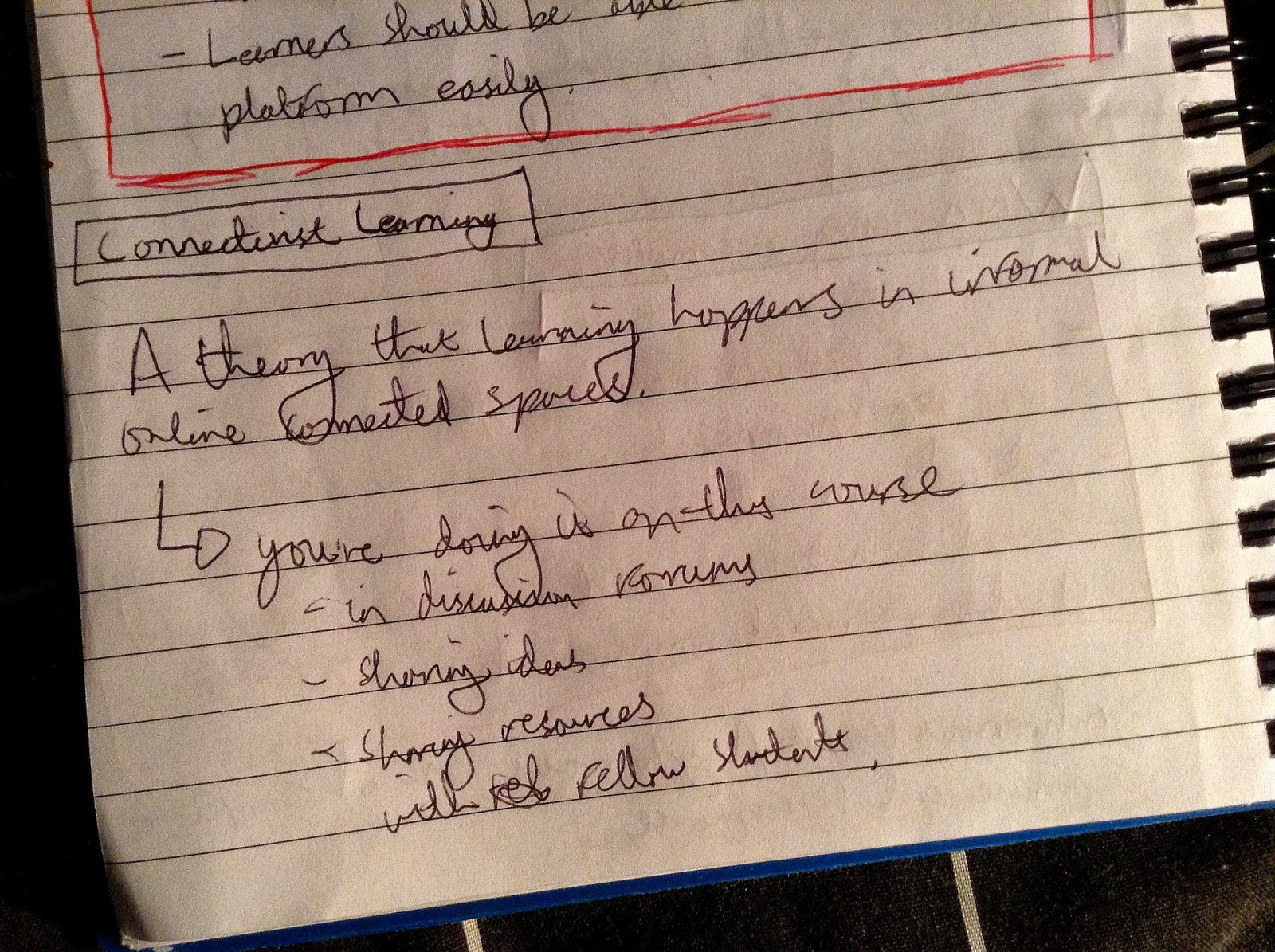
Connectivist learning - I'm doing it with this blog!


Connectivist learning  basically refers to the sharing of informative resources and discussions via discussion forums, social networks, etc., and certainly with something like language acquisition, conducting in this connectivist on an international cyberspace, the usefulness of connectivist interactions in language learning should be plain.

However, as with the second week, the third week was mainly geared towards the students who aim to go and teach language, either in the classroom or online. OR, as I pointed out, to teach language vastly more effectively by utilising a combination of classroom and online teaching.  

Ultimately, what these two weeks taught me is that if I do eventually learn a new language, then the process of learning I should employ is the process of learning I am already utilising.