Showing posts with label Creative Technologies. Show all posts

Monday, 29 July 2024

Ways 2 Interface was...

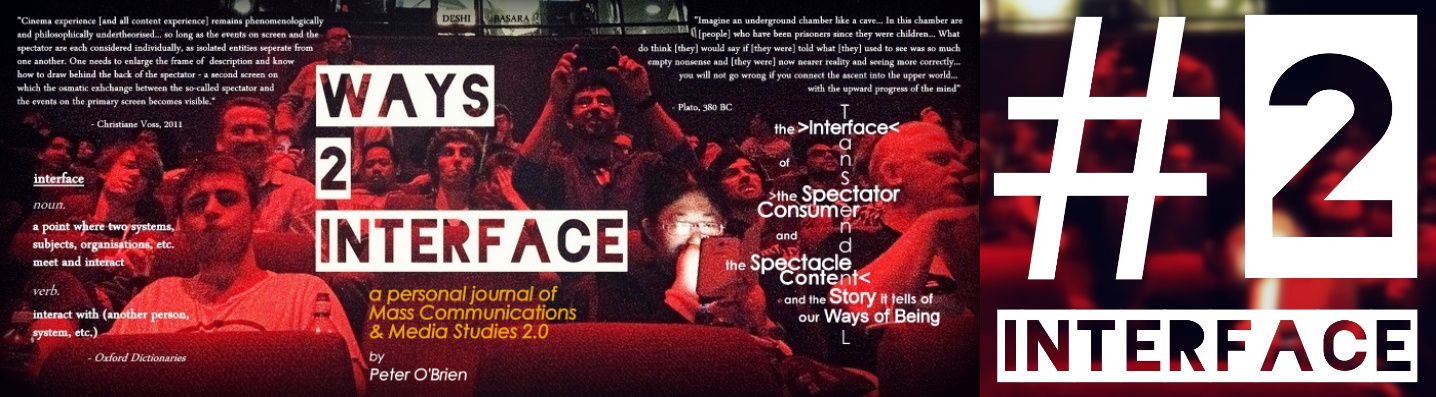
Ways 2 interface was a transdisciplinary research project, study log and personal journal I oversaw from 2014 to 2016.

I had planned to carry it over and expand it within the research focus of a traditional master’s degree in Creative Technologies and Enterprise, which I had originally signed up to undertake at the end of 2014.

Ways 2 Interface picked up where the research concerns of my BA (Hons) theoretical dissertation, Ways of Being: The Spectator and the Spectacle, had left off.

Hence the name of Ways 2 Interface, a.k.a. Phase 2.

Ways 2 Interface reconsidered the study of the content and the consumer in relation to a wider spectrum of knowledge and holistic considerations.

The fundamental focus of the project was the idea of an interfacing process – the introspective and expressive capacity inherent to us all – that we have always interwoven throughout our day-to-day existences and that we continue to do so at a formidably greater capacity in our contemporary digital realities.

By examining the habits and manifestations of our cognitive, corporeal, cultural and connected ways to interface, Ways 2 Interface aimed to build a unified understanding of this interfacing process.

Ultimately, I decided against undertaking a traditional master’s degree and instead opted to build my own master's degree which I went on to call my MTA Portfolio.

As my MTA Portfolio grew, the drive to pursue a research project to suit the requirements of a traditional master’s degree became less relevant and Ways 2 Interface transitioned away from being a research project in its own right.

It then morphed into a study log for my MTA Portfolio and then became a more general personal journal of mass communications and media studies 2.0.

With all its focuses, Ways 2 Interface accompanied and influences the construction of my MTA concentration in Multimedia Studies and Creative Technologies.

I stopped updating Ways 2 Interface in 2016.

I have since published all the unfinished and unpublished posts I originally wrote back in 2014 and 2015 in conjunction with presenting Ways 2 Interface as a component of my Creative Technologies Sandbox (which is one of the final projects for my MTA Portfolio).

I have also re-posted most of the content of Ways 2 Interface on my MTA Portfolio blog.

The Master's Degree Behind Ways 2 Interface

Ways of Being: The Spectator and the Spectacle, the theoretical dissertation I completed for my BA (Hons), was a big deal.

It was a big deal for me personally because it was a breakthrough in terms of my skill as a researcher and writer.

But it was a big deal academically too because it was a 30,000 word thesis that received the highest mark of my graduating year and was also bestowed with a research excellence award.

I had put a lot of work into and had planned to achieve a solid first from it, but I had never envisioned attaining the result I ultimately did achieve with it.

The success I achieved with Ways of Being came as a huge surprise and it opened a lot of doors; particularly regarding the undertaking of a master’s degree, which was something I had not previously given serious thought towards.

Ways of Being was a consideration of the epistemological, ontological and metaphysical downfalls of film theory’s understandings of the spectator and the spectacle; with particular emphasis directed towards the neurobiological implications of the spectator’s body.

The research focus of Ways of Being was something that I was passionately interested in and which I had only scratched the surface of within the submitted thesis paper.

There were a great deal of loose ends, both in the main body of the work and also in the appendices, that I really wanted to continue further.

In particular, Appendices A, F and I (which had once been the basis of another chapter in the main body) were two of the key sources of continuation.
I couldn't squeeze Chapter 3 into the limited word count of the main body, so it ended up becoming Appendices F and I
Ultimately, Ways of Being and its success ended up becoming the main driving for behind undertaking a master’s degree; with the potential of undertaking a PhD further down the line.

But deciding what master’s degree I wanted to pursue and how I was going to fund it took a very long time for me to figure out.

In the meantime, I decided to keep my research focus active and created the Ways 2 Interface blog where I could record my latest findings and theorizations.

As much as Ways 2 Interface was a continuation of my theoretical dissertation, it was also a continuation of my practical dissertation, EYES.

EYES was a web series concept proposal package that was a reflexive expression of contemporary networking attitudes and their implications on our ways of being.

The proposal package included a produced pilot episode, a series bible and a producer’s planning portfolio document.

The package also included a blog, EYES of a Storyteller, that I used to chronical the development of the project and Ways 2 Interface very continues in the same vein of its loose and transdisciplinary blogging style.

Ultimately, while I didn’t end up continuing my research in a traditional master’s degree, Ways 2 Interface did serve much the same bridging purpose between my BA (Hons) and the creation of my MTA Portfolio.

The curriculum of the traditional master’s degree I had planned on undertaking, Creative Technologies and Enterprise, but ultimately abandoned was also absorbed into the makeup of my MTA Portfolio.

Ways 2 Interface had a huge part to play in to create of my MTA concentration in Multimedia Studies and Creative Technologies and, for a time, very much serves as an adjunct blog to it.

Friday, 6 March 2015

No free lunch from me: Creative Technologies and Enterprise MSc - Withdrawal


If courses need to be discontinued, then courses are discontinued. If redundancies are necessary, then people are made redundant. If a new VC is required, then a new VC is hired - the educated can take care of themselves, it's the uneducated we need to start worrying about!

After much consideration, studying and an exercise of principle, today I finally withdrew from the MSc in Creative Technologies and Enterprise I have been toying with undertaking ever since graduating with my BA (Hons).

At first a very hard choice and then a surprisingly easy decision to make. Why? See the next screenshot...


Originally, Bath Spa University offered the degree to me for September, 2013; then they offered up February, 2014; with me officially settling on September, 2014 (when the degree actually launched due to enough student applications). However, feeling that there was still more I wanted to do before going back to university, I informed the university to push my entry back to September, 2015.

Now I have pulled completely.

My reasoning is thus:

  1. In the last year-and-a-half, I have covered the curriculum of the degree in the many MOOCs and independent research I have undertaken.
  2. I was not overly impressed with the interpersonal approaches or calibre of the teaching staff.
  3. I also studied my BA (Hons) at Bath Spa University and, aside from having already moved on, I am a little tired of the university.
  4. As the creative technologies side largely takes care of itself once you have acquired a proactive and progressive temperament. My main incentive behind taking the degree was for the enterprise aspect, as entrepreneurship is something that greatly excites me. I am currently working my way through my verified Specialisation in Entrepreneurship which more than makes up for (and would probably transcend) the teaching in the Creative Technologies and Enterprise MSc.

Therefore, aside from the additional material resources it would have given me access to - definitely not worth £6000 - the Creative Technologies and Enterprise MSc is now redundant.

I elaborate in the video below...


At the time of making the video above two days ago, I still had not submitted my notice of withdrawal, it was only when I read the following piece of news today, that I submitted it out of principle...


Thoughts? See screen capture below...

It's bad enough they decided to bury their heads in the sand when the government decided to increase the tuition fees, but you must be joking if you think I going to enrol in a university headed by a Vice Chancellor who reinforces the rising of tuition fees by spending tax payers money in order to go globe-trotting to recruit international students to fill the empty spaces.

Not only is it infuriating to the UK students who really do want and need to go to university, but it's insulting to the international students who are being conned into fronting the bill.

If courses need to be discontinued, then courses are discontinued. If redundancies are necessary, then people are made redundant. If a new VC is required, then a new VC is hired - the educated can take care of themselves, it's the uneducated we need to start worrying about!

Hence why I did not go to my graduation. I was a little angry about the whole affair.


What's even more infuriating about this insult is that I am now ashamed to admit that I studied my BA (Hons) at Bath Spa University.

But I never actually went to my graduation ceremony, so can it really be said that I did go there?

At the very least I did not contribute any money towards the VC's lunch.

Bath Spa University, I am grateful for the masters offer and I am flattered that you offered it to me on the strength of my BA (Hons), but this is my final answer...

No, thank you. The VC can buy her own bloody lunch!

Monday, 1 December 2014

The web is not an exact science - Web Science - week 1 reflection #FLwebsci #MOOC


Web Science is inherently transdisciplinary as it is employs many analytical techniques and knowledge bases from other subjects, such as economics, law, psychology, sociology, computer science, etc., hence why I am drawn so much to this subject. The aim is for Web Science to operate very much outside of the box in order to consider the thing we have come to call the web - a thing that keeps growing, that keeps changing and that is anything but an exact science!


Back in February I started the Web Science MOOC as presented by the University of Southampton on FutureLearn, but I struggled to find a way into sticking with the essential focus of its topic. 

What is Web Science?


The main problem was that I lacked a technological foundational understanding in how the web actually works on a software and hardware basis. Therefore, after completing the first-and-a-half weeks, I decided that I would come back to the MOOC at a later date, once I possessed a better foundational understanding.

One of the great things about many MOOC platforms is that they let you retain access to the course materials long after the course has completed.


However, now that I have dabbled a little with coding and have (nearly) finished the Internet History, Technology and Security MOOC, I now possess a basic understanding of the operational processes behind the internet. 

Additionally, while I was undertaking the Internet History, etc. MOOC and also its kindred Introduction to Cyber Security MOOC, I noticed that my attention kept shifting back to this Web Science MOOC.

As I was coming to understand the workings of the internet, I noticed that I started to look at my daily usage of the internet in a very different way: a very analytical manner not too dissimilar to the perspective the Web Science MOOC had started to nurture in me...


Web Science - an introduction to a bold new academic discipline.

Web Science is inherently transdisciplinary as it is employs many analytical techniques and knowledge bases from other subjects, such as economics, law, psychology, sociology, computer science, etc., hence why I am drawn so much to this subject. The aim is for Web Science to operate very much outside of the box in order to consider the thing we have come to call the web - a thing that keeps growing, that keeps changing and that is anything but an exact science!

The tangled pre-history of the web.


Week 1 of the MOOC provides a brief pre-history and and recent history of the web and this is something that Internet History, etc. has gone into vastly more detail and is accordingly vastly more enlightening. 


Tim Berners-Lee is where the 'web' begins, he is not where the 'internet' begins.


I believe this lack of in-depth consideration of the various phases of the webs history is where I felt really let down and unclear about when I first undertook the MOOC back in February. 

However, I can not really blame the course as it is called 'web science', not 'internet science' and, therefore, is not concerned with the web's precursor before Tim Berners-Lee's proposal for the World Wide Web in 1989 (also the year I was born). Obviously you will need to possess some historical background context for this subject, but for a short course offering, such as this MOOC, you can only expect it to cover so much.

Ultimately, the aim of this short course MOOC is to supply you with the basic tools in order to encourage you to proactively think much more analytically about the web, how it is changing the world and what role you have to play in this new technology. 

One of the best ways in which the MOOC achieves this in week 1 is in its consideration of technological determinism and in questioning its position that technology is shaped by society in social construction.


Does technology shape society or does society shape technology?


The argument for and against technological determinism was something that was heavily touched upon in the E-Learning and Digital Cultures MOOC I undertook previously. While the concept of technological determinism was introduced to me I did not really grapple with its larger implications.


E-Learning and Digital Cultures was not a MOOC with which I really thoroughly stuck.


Additionally, technological determinism is not something that was really dealt with in my Film and Screen Studies BA (Hons) either, as technological determinism is something that is more integral in Media Communications concerns. 

However, while it was never the primary agenda, technological determinism can be seen to have a part to play in my theoretical dissertation Ways of Being: The Spectator and the Spectacleessentially that the new technologies of cinema were arising out of a consumer demand for bigger film experience immersion. 

Therefore, my view is very much in favour of social construction, not technological determinism, and this is the same view that the Web Science MOOC adopts.


Why is a discipline such as Web Science is so integral?


"There are some bits of technological determinism that work. Certainly, the kind of technology in the Web, its openness, its democratic features, those things shape how the Web is. But there are other things which are very much part how we, as human actors and agents and societies, take that technology and do all sorts of different things with it, things that Tim Berners-Lee couldn't even have imagined, so Facebook or Twitter, for example" 
- Catherine Pope, Web Science educator.

Technology does not just change us, it is much more about us influencing technology - the web is a major and direct example of this. 


Social shaping vs. technological determinism - which do you support?

On the whole, social shaping has become the dominant view and the web in particular is a primary example of how society shapes new technologies to fit the needs of society:


"The state of the market, or better, of society is the crucial factor in enabling the development and diffusion of any communications technology or in hindering it. That is as true of the computer chip and the Internet as it was of the telegraph and the telephone. Thus, innovations are the creatures of society in a general sense." 
- Brian Winston, Technologies of Seeing, 1996:3.
This is why the further development of a discipline like Web Science is so strongly advocated and needed. 

Certainly, in terms of Film and Media disciplines, this is what I was getting at in Ways of Being


"In short, there is too much indifference in Film Studies.The discipline is too focused on cave-like thinking and film theory of the past; a pantheon of knowledge that is becoming continuously outdated and finding itself at odds with new advancements and diversifications, such as the digital re-birth and large format hypercinema. Film scholars have always sought to understand the spectator’s and spectacle’s mutual pursuit of enlightenment; while they have uncovered aspects of it, there still does not exist a single unifying explanation of the profound processes of that relationship" 
- Ways of Being, 2013:105.

However, while my focus may have been towards Film and Media disciplines, by not considering the networking-and-interactions of these technologies and processes is insane and this is very much the incentive behind creating Ways 2 Interface.


Some notes I made while planning out Ways 2 Interface.


I have created Ways 2 Interface as a web blog precisely because it is considering the relationship of the spectator and the spectacle in film and media as connected globally in the thing we have called the web - it is analysing the the very thing of which it is a part. 

"Everything that has been presented throughout this paper is representative of the shift in thinking that is slowly taking place alongside the digitalisation of cinema and needs to continue to take place! In moving away from the cave, we have stopped viewing spectacle content on a screen, and we now experience and interact with it via an interface. If there is a great deal of neurobiological participation happening on the spectator’s part, then perhaps this offers a more accurate way to talk about the process by which the spectator interfaces with any type of film spectacle. While this section can not hope to provide many answers to the questions it has raised, one obvious conclusion should be apparent - all these diverging means of experiencing the world will continue to have huge implications on our ways of being in the world"
- Ways of Being, 2013:151.

Ultimately, the web has adopted cinema into its paradigm and this is the reason for why I am so fascinated by the web - it's a direct and vastly intricate expression of the relationship of the spectator and the spectacle like we have never seen before!

Certainly, Web Science will be huge help and an additional component of this transdisciplinary consideration I have taken up.

Is the web guaranteed to exists indefinitely? 

I am currently undertaking quite a few MOOCs (as always) and while I do plan to finally work my through and finish the Web Science MOOC, it may not be any time soon, I will be engaging with the MOOC materials whenever I can make the time for them.

However, I do not think that making time will be a problem as it is clear that the knowledge this MOOC will nurture in me will have a clear and primary role to play in my further studies and research interests.


The web a.k.a. unlimited potential. We have barely scratched the surface. 


The web is for everyone and for everything, but it is not an exact science, it is something that we have to keep working at in regards to how we further develop it and how we continue to analyse it.

That's Web Science.